
The Colosseum, we agree, is the symbol of Rome and its history, but have you ever wondered why it is called that?
The name “Colosseum,” in fact, was not the original name, but came about in later centuries for a very specific reason.
Not everyone knows that the Colosseum owes its name to something… gigantic!
Want to learn more about it? Find out the true origin of this word and its connection to a Roman emperor.
And no, it has nothing to do with the Flavian dynasty that had the amphitheater built. Read on to discover the fascinating story behind the Colosseum’s name.
A MOMENT! If you want to see this extraordinary monument in person, then I recommend booking your tickets online. This is the only way to guarantee you access on the day and time you want, without wasting time at the ticket offices! What are you waiting for, book now and discover the history of the Flavian Amphitheater!
The best-selling
Colosseum and Roman Forum Ticket + Audio Guide
Fast-track access and audio guide included: explore Colosseum and Roman Forum with one ticket.
from 25€
Full Ticket
Secure payment
Instant confirmation
Mobile ticket
The original name of the Colosseum

Interior of the Colosseum, painted by Thomas Cole, 1832
The Flavian Amphitheater: the official name
Actually, the Colosseum’s original name was the Flavian Amphitheater, in honor of the dynasty of Flavian emperors who had it built.
Work was started by Vespasian in 70 AD and completed by his two sons, Titus and Domitian.
When, in April 21, 80 AD, Titus had the Colosseum inaugurated, it was therefore not by this name that spectators called the amphitheater, but this came only later, and for a very specific reason.
From Flavian Amphitheater to Colosseum: the link with Nero

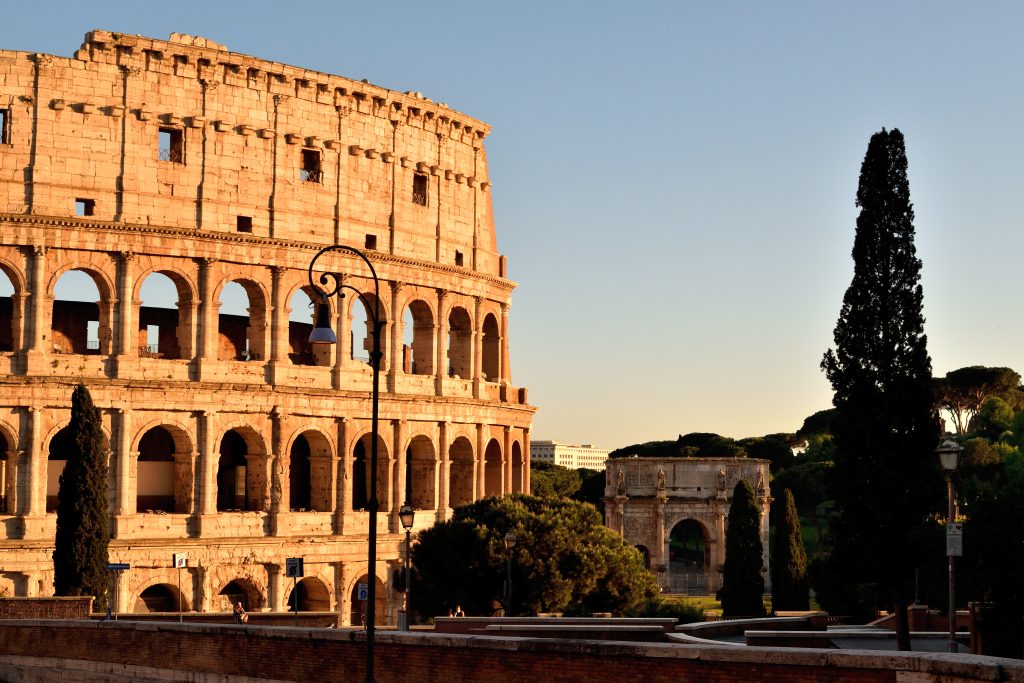
Colosseum seen from the Palatine Hill
The Colossus of Nero: the giant statue
The Colosseum rose in an area that Nero had appropriated by depriving citizens of access to it.
His residence, the Domus Aurea, was embellished with an artificial lake: it was after draining this lake that the Flavian dynasty erected the amphitheater.
Next to that precious body of water stood a colossal statue of Nero, about 35 meters high.
The statue represented the emperor as a solar deity and was inspired by the Greek Colossi, such as the Colossus of Rhodes, that is, with his right arm forward and leaning on a rudder, while with his left arm he held a globe.
On her head she wore a crown with seven long rays.
The reuse of the statue after Nero’s death
After Nero’s death, the statue was modified and dedicated to the Sun god as the figure of Nero was affected by Damnatio memoriae.
In 127 AD, the emperor had it moved to have the temple of Venus and Rome built there.
For a time, Emperor Commodus turned it into a statue of himself, but it was restored to its previous condition after his death.
Then only the tuff foundation remained of the statue, while the rest was probably lost during the sack of Rome in 410 or by an earthquake in the 5th century.
The metal of the Colossus was reused because bronze was a material in high demand and not easy to obtain.
In time, the gigantic amphitheater was named after the statue itself-the term “Colosseum,” in fact, would be derived from Nero’s Colossus.
The best-selling
Colosseum and Roman Forum Ticket + Audioguide
Fast-track access and audio guide included: explore Colosseum and Roman Forum with one ticket.
from 25€
Full Ticket
Secure payment
Instant confirmation
Mobile ticket
Curiosities and myths about the name of the Colosseum
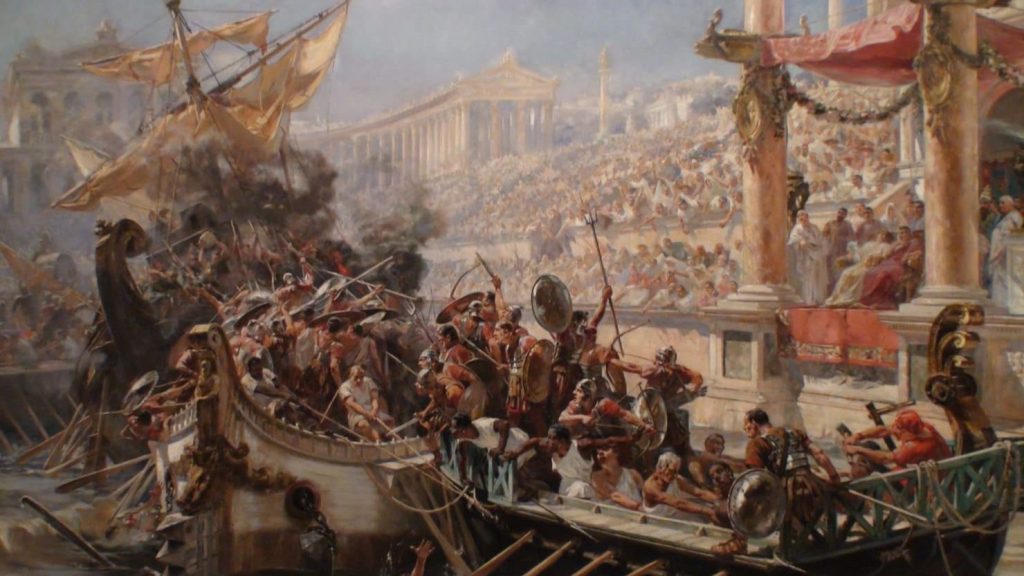
An example of Naumachia, from a painting by Ulpiano Checa (1894)
Want to know two curiosities related to the Colosseum that make it an even more fascinating historical monument? Here you are satisfied!
The medieval legend
A legend arose in the Middle Ages that the Colosseum was inhabited by spirits and demons.
Some even said that Nero’s statue hid an entrance to the underworld, directly even to the underworld.
This fame accompanied the Colosseum for a long time: for example, Benvenuto Cellini, one of the most important exponents of Mannerism, told in his autobiography of a night when demons were summoned inside the amphitheater.
In 1675 it filled the role of a sacred place to commemorate Christian martyrs, and in 1749 Pope Benedict XIV declared it a church consecrated to Christ and precisely to Christian martyrs.
The influence of popular culture
Here’s another fun fact for you: the term “Colosseum” became so popular that the Flavian Amphitheater, in fact, changed its name.
In fact, beginning in the Renaissance, the amphitheater came to be called that in official documents as well.
Frequently asked questions
The Colosseum took this name because a gigantic statue, a Colossus of Nero as high as 35 meters, stood near the amphitheater.
The Colosseum was actually originally called the Flavian Amphitheater: its name was due to the family of the emperors who built it, the Flavian dynasty. It was in fact at the behest of Vespasian and later his sons Titus and Domitian that the area was returned to the Roman citizens after Nero’s death, to the point that the Colosseum was a kind of gift to the people.
The term “Colosseum” spread during the Middle Ages and is derived from the Latin adjective “colosseum.” Transformations were due to popular distortions as the plebs did not speak Latin correctly, but going back to its etymology it could be translated as “colossal”
The Colosseum’s real name was Flavian Amphitheater. However, since the Renaissance the term “Colosseum” also began to appear in official documents.
Conclusion

Underground and Arena of the Colosseum
We have come together to the end of this article in which I told you the story related to the name of the Colosseum.
We found out together why the Colosseum is called that, and now you know that it was originally known as the Flavian Amphitheater.
I told you that this name change was due to the huge statue of Nero that was located near the monument, and it is to her that we owe the origin of the name.
In addition, now you also know some legends related to this place and how the new name spread over time.
Did you know this story? Did you know that in the Middle Ages people began to think that the Colosseum could lead to the underworld and was a place frequented by demons? Tell us in the comments what you think!
And do you believe this legend? If you want to come and see the Colosseum live, don’t waste your time at the ticket offices! Book your tickets now and discover its incredible story !
The best-selling
Colosseum and Roman Forum Ticket + Audio Guide
Fast-track access and audio guide included: explore Colosseum and Roman Forum with one ticket.
from 25€
Full Ticket
Secure payment
Instant confirmation
Mobile ticket
