
The Colosseum is the symbol of Rome and one of the 7 wonders of the modern world.
While it was once the emblem of imperial heyday, today it unfortunately does not appear as it was, covered in marble, decorations, statues and most importantly… whole!
Today we see it “ruined” and without a whole part. Why did it break? And what has damaged it over the centuries?
Do you also think it is solely the fault of the years that the Colosseum is broken today? Think again! Find out what events have really challenged this ancient Roman amphitheater.
Did you know that not everything you see today is original?
Read on to find out the history of the damage to the Colosseum, what caused it, and what happened; as you read, you will also know what has endured to this day.
ALT! Want to see the grandeur of the Colosseum in person? The first thing you need to do is book your tickets well in advance.Choose your tickets now and get ready to immerse yourself in the history of Rome: broken or whole, the Flavian Amphitheater always knows how to give unique emotions!
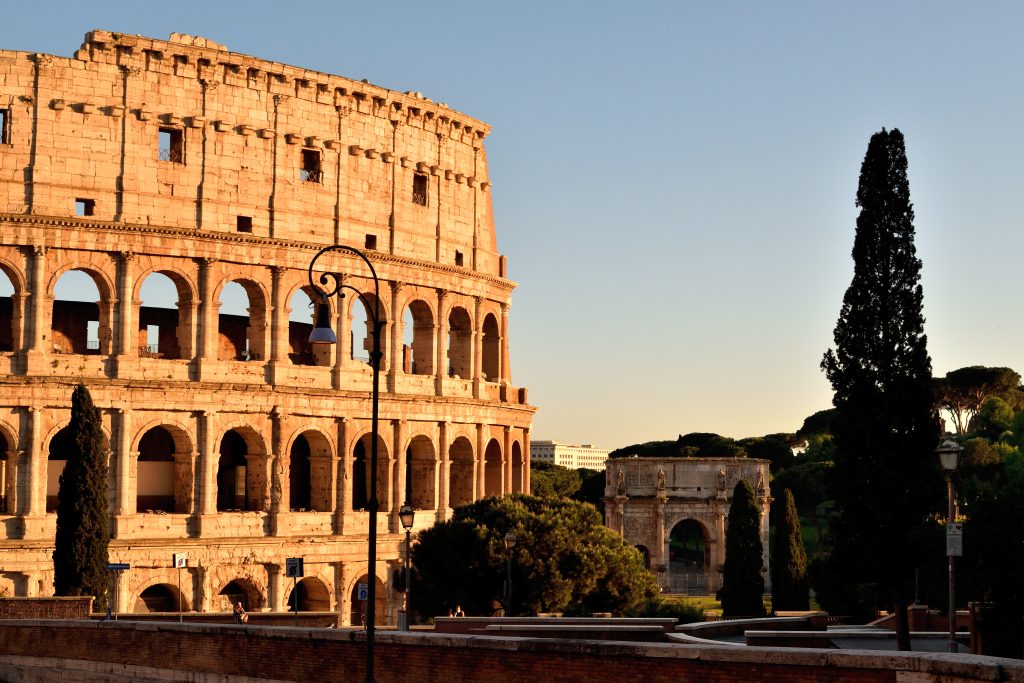
The best-selling
Colosseum and Roman Forum Ticket + Audio Guide
Fast-track access and audio guide included: explore Colosseum and Roman Forum with one ticket.
from 25€
Full Ticket
Secure payment
Instant confirmation
Mobile ticket
The Colosseum: a giant wounded by time

Engraving by Piranesi depicting the Colosseum with the aedicules of the “Way of the Cross”
Resilient, but not indestructible architecture
The Colosseum was built to give luster to imperial power and designed to host events and performances.
Also considering the large number of spectators it could accommodate (estimated at over 50,000), the Colosseum was designed to combine strength and architectural splendor: a variety of materials were used, including travertine, tufa, brick , and marble.
The choices of the Romans were certainly excellent; in fact, the Colosseum has endured for nearly 2,000 years, despite also falling into disuse for centuries.
Its structure was designed to last a very long time, and the Romans thought they could preserve it exactly as the spectators saw it during the inaugural games, but certain events have actually compromised its integrity.
Early signs of failure
As early as medieval times the Colosseum began to show the first damage, but the real problems came later.
It was mainly several seismic episodes that undermined the integrity of the building, but it was not only nature: having lost its role after the collapse of the Western Roman Empire, the amphitheater was used for a great many purposes and became almost an open-air quarry, as anyone could take useful materials for a wide variety of purposes.
The main causes of the ruin of the Colosseum

Interior of the Colosseum, painted by Thomas Cole, 1832
Earthquakes: the force of nature against the Colosseum
Several earthquakes have struck Rome over the centuries. Actually, Rome is not a city at high seismic risk, but in its history it has suffered damage from major earthquakes even with distant epicenters.
Despite the distance, the propagation of seismic waves underground has produced subsidence in the Colosseum area due to poorly compacted soils from underground construction.
There were several earthquakes that struck the Colosseum, but the most devastating were those of 443 A.D., 847 A.D. and 1349, which caused entire sections of the amphitheater to collapse.
In particular, in 1349 the entire southern part of the amphitheater was destroyed. It is no coincidence that this earthquake, with its epicenter in the Central Apennines, caused only a part of the Colosseum to collapse: the northern part, in fact, rested on well-resistant volcanic stones that allowed the building to withstand the tremors.
The part that collapsed, however, was the part underneath which was soft subsoil, due to fluvial sediments from the previous use of the area: this was where the artificial lake wanted by Nero to embellish his mansion stood.
The reuse of stones: a Colosseum disassembled piece by piece
As if that were not enough, after the fall of the Roman Empire, the Colosseum lost its importance to the point of not only the cessation of events within it, but even its abandonment.
Deprived now of usefulness and the empire having ceased to exist, the Colosseum became a kind of “quarry” of materials: here it was possible to find marble, travertine and other stones that would have been complex to find elsewhere.
Travertine and marble were reused to build palaces and churches by official administrations: for example, they were used in the building site to erect St. Peter’s in the Vatican or Palazzo Barberini.
But not only for these purposes: private citizens also made the Colosseum a quarry to source materials.
Small parts were taken from the stones and even the metal brackets used to hold the blocks together. That’s why when you visit the Colosseum you will find many holes in different parts!
The neglect and medieval settlements
Neglect also caused the decay of the Colosseum. In the Middle Ages, in fact, the amphitheater was used for a wide variety of purposes: it was a burial site, for example, but not only that.
Did you know that it was turned into a fortress by powerful noble families? During the Middle Ages , the Frangipane family made it a power building of their lineage, complete with a wooden walkway used for patrolling.
Later it also became an inhabited area, with houses and even a church built within it.The Coliseum provided cover in case of bad weather conditions and, given its abandoned state, was exploited by many people with few economic resources.
It was even used as a stable, precisely because it provided cover for the animals.
What remains of the Colosseum today?
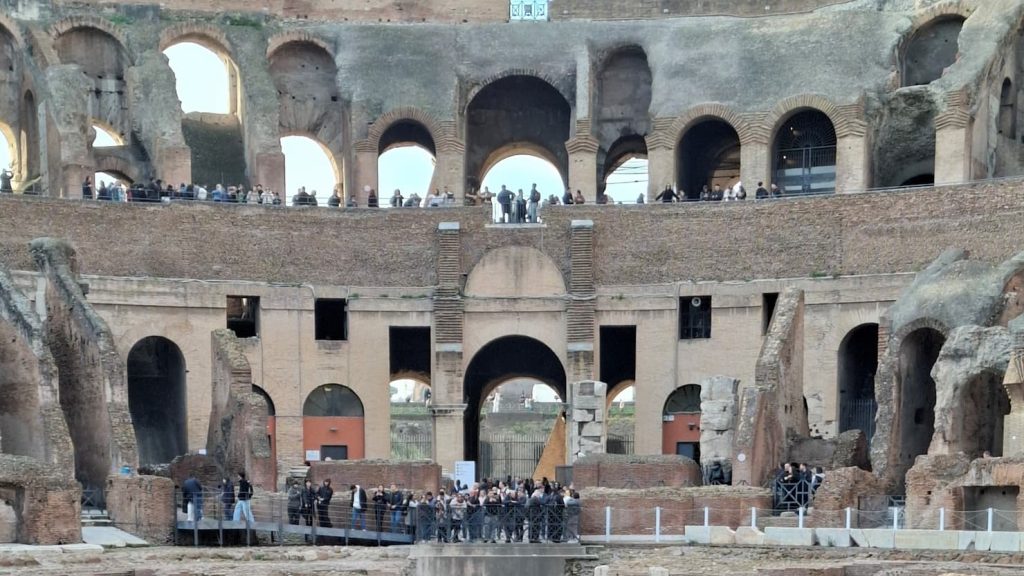
The interior of the Colosseum
The restoration and conservation
From the nineteenth century, important work was begun to preserve the Colosseum, directed by Carlo Fea. Important was the intervention of Raphael Stern who, in 1806, worked on the eastern part of the Colosseum.
Thanks to him unstable arches were walled up and a brick spur was introduced with the aim of supporting the structure, particularly the outer end of the ring.
The western part, on the other hand, was restored by Giuseppe Valadier: he too had a support built for the structure but then decided to rebuild the arches, imitating the Roman style as closely as possible.
Finally, in the mid-19th century other interventions ensured that the southern part, the one most affected by earthquakes, was also reinforced.
Gaspare Salvi took charge of this and chose to follow Stern’s working criteria and thus not replace any original parts.
Today the Colosseum is one of the most visited sites in the world and a symbol of Roman history, not to mention the whole of Italy.
Admired worldwide, it is listed as a UNESCO World Heritage Site and among the 7 Wonders of the Modern World.
Frequently asked questions
The Colosseum collapsed in half due to seismic phenomena. Specifically, the southern part collapsed since that part of the ground was soft and water-run: the aqueduct used by Nero to feed his artificial lake passed through here. During the earthquake, this presence of water in the ground prevented the southern sector of the Colosseum from resisting the tremors, which happened instead to the northern part since it rests on ground characterized by the presence of volcanic rocks.
The Colosseum is missing a piece because of earthquakes that affected the area. The materials, moreover, were taken to build other buildings.
The Colosseum has many holes for several reasons: partly because materials and parts of the stones, such as marble or travertine, were taken out, but partly because the stones themselves were dug out to recover the metal grapples inside. Being uncommon and expensive materials, there were many who plundered the Colosseum and used it as if it were a quarry.
The Colosseum could be filled thanks to the Claudian aqueduct, already exploited by Nero to feed his own artificial lake inside the Domus Aurea. The same aqueduct filled the Colosseum arena, and was able to do so in an incredibly short time.
Conclusion
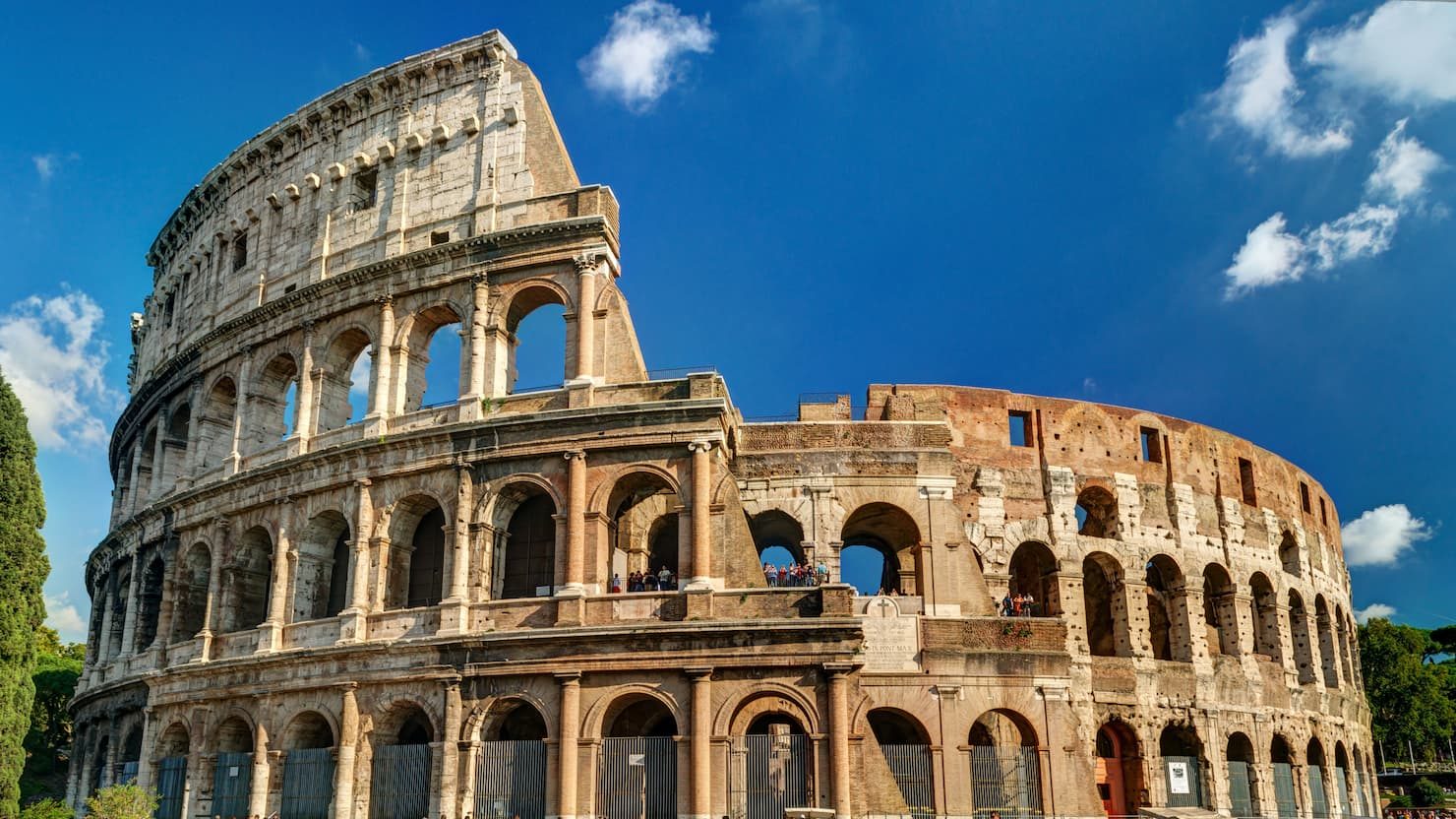
Front view of the Colosseum | ID 32557903 © Scaliger | Dreamstime.com
Well, here we are at the end of this in-depth look at the condition of the Flavian Amphitheater. We have seen together why the Colosseum was ruined and today it appears as we see it.
Now you know that at the time of its construction it was very different, enriched with statues and precious marble, but over the centuries it has changed: the causes are natural, but not only.
In fact, I explained to you that most of the damage was caused by earthquakes, but human intervention was also instrumental.
You were able to read that the Colosseum was used as an open-air quarry and that materials taken here were used for the construction of other buildings in Rome, but I also told you how the Colosseum was used as a fortress, burial place, dwelling place, and much more.
Finally, I also told you what was done to preserve it and try to restore it, before answering the most common questions on the subject.
Do you still have any curiosities? Have you ever been inside the Colosseum and would like to tell us your thoughts? Write to us in the comments!
Now that you know these peculiarities of the Colosseum’s history, are you looking forward to admiring it with your own eyes? Then I suggest you book your tickets so you can enjoy many benefits, including priority access.
Veni, vidi… and experience history firsthand!
The best-selling ever
Colosseum and Roman Forum Ticket + Audio Guide
Fast-track access and audio guide included: explore Colosseum and Roman Forum with one ticket.
from 25€
Full Ticket
Secure payment
Instant confirmation
Mobile ticket
