
The Colosseum is one of the most visited monuments in the world, and hosts millions of visitors every year, but what can you see inside it?
There are multiple areas accessible with different tickets: from the dungeons, where gladiators were prepared and animals were kept, to the arena, where the public could watch the shows.
But even the rings intended for spectators and the entrances can be visited: discover the most fascinating areas of the Flavian Amphitheater!
In this article I’ll tell you about each area of this splendid monument, but mind you! Visiting the Colosseum from the inside is an experience that cannot be told: you can walk where gladiators once fought and discover the hidden secrets of the most famous arena in history.
Here, then, is a detailed guide on what to see inside the Colosseum and how to best organize your visit, with tips and trivia.
WAIT! Before we continue, let me give you a hint! Buying your ticket online will entitle you to many benefits: for example, you will be able to skip the line, access the most exclusive areas of the Colosseum and even get discounts thanks to combined tickets valid for multiple attractions! What are you waiting for? Book now and enjoy your visit without stress!
The best-selling
Colosseum and Roman Forum Ticket + Audio Guide
Fast-track access and audio guide included: explore Colosseum and Roman Forum with one ticket.
from 25€
Full Ticket
Secure payment
Instant confirmation
Mobile ticket
- 1 Architecture and internal structure of the Colosseum
- 2 The Colosseum arena: the stage for performances
- 3 The underground of the Colosseum: the behind-the-scenes of the shows
- 4 The bleachers and audience sectors
- 5 The inner passages and arches
- 6 Exhibitions and cultural events at the Colosseum
- 7 Frequently asked questions
- 8 Conclusion
Architecture and internal structure of the Colosseum
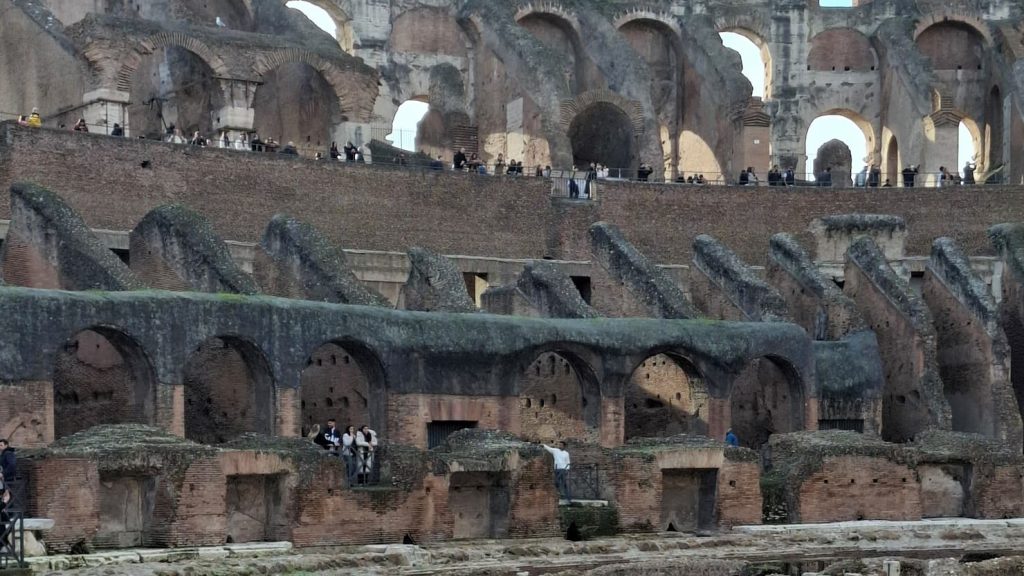
The rings of the Colosseum
Inside the Colosseum there are several sections, each of which had a specific function.You should know that this amphitheater was designed to hold over 50,000 spectators and was designed just like a modern stadium. Today you can visit:
The arena
This was the real heart of the show: this was where the animal hunts or the incredible fights to the death between gladiators took place.
The dungeons
This area, on the other hand, includes the tunnels hidden beneath the arena that were used to prepare for performances. We might call them the “backstage” of the Colosseum.
The bleachers
Just as in a modern theater or stadium, spectators watched events from here. Sections were divided according to social rank, and each visitor had to enter through a specific entrance so that he or she would definitely have access to his or her section, just like the gates in today’s facilities.
The corridors and arcades
True architectural gems, they are among the elements that best reveal the genius and care of Roman engineering.
The Colosseum arena: the stage for performances

Underground and Arena of the Colosseum
The arena was the central part of the amphitheater; its elliptical shape was specially designed to facilitate the view of spectators and prevent gladiators from getting stuck in the corners: this ensured dynamism in the fight.
Its measurements are incredible; it is no coincidence that it is the largest Roman amphitheater in the world: in fact, it is about 86 meters long and 54 meters wide.
At one time it was covered with a floor made of wood and sand. Are you wondering why? Simple, the sand served to absorb blood and make cleaning easier and faster.
This was where gladiator fights, animal hunts, and mythological performances took place, and before the construction of the dungeons, this was the flooded area for representing naumachiae.
After Domitian had the dungeons built, however, the arena allowed them to be hidden from public view, and this ensured exceptional stage effects organized in the tunnels under the pavement.
Today, a part of the arena has been reconstructed and allows visitors to walk right where the fights once took place, observing that sand up close. Only a small part of the arena, however, has been restored; the rest, however, is empty, and so it is possible to observe the very dungeons.
Points of interest in the arena
Access to the arena provides an incredible panoramic view of the Colosseum from inside. Have you seen the movie “The Gladiator?” From here you will feel just like those valiant fighters!
The reconstructed wooden floor serves an important and valuable purpose: it allows you to understand the original structure, while at the same time leaving you the opportunity to observe the workings of the dungeon.
Caution Remember that the standard Colosseum ticket does not include access to the arena. Choose an exclusive ticket: lots of benefits for you, such as guided tours, and especially access to this area of the amphitheater.

The best-selling
Colosseum and Roman Forum Ticket + Audioguide
Fast-track access and audio guide included: explore Colosseum and Roman Forum with one ticket.
from 25€
Full Ticket
Secure payment
Instant confirmation
Mobile ticket
The underground of the Colosseum: the behind-the-scenes of the shows

Underground of the Colosseum | ID 256339538 @ Sean Pavone | Dreamstime.com
The dungeons, known as hypogeum, were a labyrinth of corridors and rooms hidden beneath the arena.
This was where performances were prepared with traps, animal elevators, and secret passages for gladiators. It was in this area, in fact, that the events that the public admired on the arena were organized and managed.
In the original design of the Amphitheater, the basements had not yet been contemplated, so the Colosseum could also accommodate the naumachiae.
After their construction by Domitian, it was no longer possible to flood the amphitheater, but all other performances benefited.
In fact, it was in the dungeons that gladiators waited before making their entrance: thanks to a system of hoists and trapdoors, the audience could see fighters suddenly appear-but not only that!
Ferocious animals and parts of the set design would also appear on the arena to the general amazement.
There were many people working in these tunnels to operate the shows. To accomplish this, a winch system operated by ropes was used.
There were also wooden platforms that could rise up to seven meters and took advantage of the interlocking on the walls of the dungeons to descend: you can still see the tracks carved into the stone on which the platform slid.
What to see in the dungeons
Did you know that the dungeons can be visited? Tunnels and original rooms await you-you can wander right where slaves and animals awaited their entry into the arena.
As you visit this area, you’ll be able to see up close the remains or reconstructions of Roman machinery, used to lift cages, so you can understand their scope and operation.
Plus,scenic lighting will give you an immersive experience. Sometimes, events and exhibitions are organized here: did you know that in the past, scenes showing the gladiators’ preparation before battle were projected on the walls of the dungeon? A great idea to blend history with entertainment!
Remember that the dungeons are only accessible by guided tours, so it is advisable to book in advance online.
The bleachers and audience sectors

Detail of the Arch | ID 52305377 @ Andrei Stancu | Dreamstime.com
The Colosseum could accommodate about 50,000 spectators, although some historians claim it could reach a capacity of nearly 75,000.
But the Colosseum was not only built to accommodate all these spectators, but also to be able to divide them into sectors according to social class.
Did you know that each spectator had his or her own entrance so as to avoid mixing with other social classes?
The different levels
Podium
This was the first row, reserved for the emperor and senators: each had his own throne. It was also possible to see here seated important public guests invited by the emperor himself. Today we would say, “special guests!“
Maenianum primum
It comprised 8 marble steps and was intended for the aristocratic class.
Maenianum secundum
The most capacious sector that was divided into two parts: the one intended for the wealthiest was called imumum and housed the equestrian order, while the one reserved for the poorest was called summum and this was where the common citizens and plebs were located.
Maenianum summum in lignes
It consisted of 11 wooden steps, just below the velarium at the highest part. This was where the women gathered.
This area, in fact, was built by Domitian to separate men and women since the games were an occasion for them to unite and gave rise to gossip.
The best-selling
Colosseum and Roman Forum Ticket + Audio Guide
Fast-track access and audio guide included: explore Colosseum and Roman Forum with one ticket.
from 25€
Full Ticket
Secure payment
Instant confirmation
Mobile ticket
The inner passages and arches

Entrance to the arena of the Colosseum
One of the most fascinating aspects of the Colosseum is the system of passageways and arches that allowed for the rapid access of spectators and the movement of performers and fighters.
Architectural elements to observe
The monumental arches
There are 80 of them and they give depth and momentum to the structure. They were important because they represented the entrances for the public: 76 were for the normal public, while 4 were placed at the end of the main axes and were only for the emperor, political and religious authorities, and gladiators before they accessed from the dungeons.
All the arcades were numbered so that every citizen knew from where he or she had to access.
The inner corridors
They were designed to quickly triage the audience. In fact, just as in a modern facility, they were designed to make the audience flow quickly to the exit or to allow them to reach their own section.
According to historians, the entire Colosseum was able to empty out in a matter of minutes!
The inscriptions and decorations
Sometimes still visible, they are one of the most interesting points inside the amphitheater: they tell the story of the ancient performances.
These details are essential if you really want to understand the grandeur and importance of the Colosseum: it was indeed a building of incredible modernity and innovation for its time.
Only by seeing these parts with your own eyes can you understand the exceptional Roman engineering and the complexity of the logistics within the Colosseum.
Exhibitions and cultural events at the Colosseum
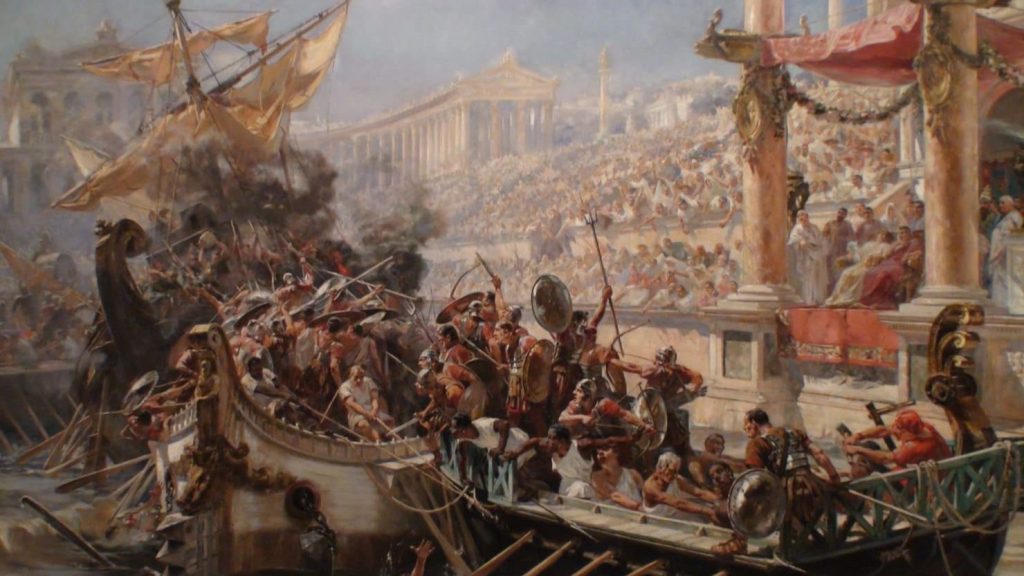
Naumachia, from a painting by Ulpiano Checa
Entering the Colosseum is not just about admiring the grandeur of one of the wonders of the ancient world: often, stepping through its arches also means discovering exhibits and installations that enrich the experience with original and evocative content.
The Colosseum Archaeological Park, in fact, regularly organizes temporary exhibitions that span art, archaeology, history and culture, offering novel insights even to those who think they already know the Flavian Amphitheater.
The Colosseum is never the same. Every visit can become a new experience thanks to these constantly updated cultural initiatives. If you want to stay informed about exhibitions, events or any extensions, keep an eye on this site.
For current exhibitions, you can read our article “Colosseum Programming: Concerts, Events and Shows.”
Frequently asked questions
Different types of spectacles were organized inside the Colosseum. The most eagerly awaited events for the public were the gladiator clashes that took place between two fighters belonging to different gladiatorial schools. But other types of games were also organized at the Colosseum: hunts of exotic animals, clashes between gladiators and ferocious beasts, and even naumachiae, or naval battle (until Domitian had the basement built and it was no longer possible to flood the Colosseum).
Today, inside the Colosseum you can admire different areas, each of which provides excitement and curiosity. You can visit the arena where the shows were staged and step on the same sand on which the gladiators fought. However, the arena that exists today is only a part of the one from Roman times; instead, today you can admire the dungeons built beneath it. The narrow corridors can also be visited if you wish, and they give a truly complete experience, but you can only access them with a guided tour. Finally, you can also visit the bleachers at various levels so you can admire the amphitheater from above as well as take a closer look at the seats intended for the various spectators.
The Colosseum is not whole because it suffered major damage from seismic events: several earthquakes in fact caused some areas of the amphitheater to collapse. In addition, after its abandonment, the Colosseum was used as an open-air quarry to find useful materials for the construction of other buildings.
Entering the Colosseum is a truly unmissable experience! This amphitheater is the symbol of ancient and modern Rome, capable of attracting millions of visitors every year. It is no coincidence that it has been listed among the 7 Wonders of the Modern World, and only by accessing its interior on a full tour can you truly understand all the wonder and fascination it conceals.
Conclusion

Interior of the Colosseum | ID 203021738 © Jozef Sedmak | Dreamstime.com
Here we come to the concluding part of our article on what to see inside the Colosseum.
We explored together what you will be able to find inside the Colosseum, discovering its internal architecture.You discovered that by visiting the Flavian amphitheater you can see the arena, where the gladiators fought, the dungeons, the area where events were run and functioned as a “backstage,” and the audience sectors, divided according to social classes.
Finally, I answered the most common questions about the Colosseum: still have doubts? Leave us a comment and we will be happy to satiate your curiosity!
If you have already visited the Colosseum, tell us in the comments about your experience: we will be happy to read it!
If, on the other hand, you haven’t had a chance to see the Colosseum with your own eyes yet, don’t miss the chance to experience the world’s most famous amphitheater from the inside: buy your ticket online and get direct access without waiting in line!

The best-selling
Colosseum and Roman Forum + Audioguide Ticket
Fast-track access and audio guide included: explore Colosseum and Roman Forum with one ticket.
from 25€
Full Ticket
Secure payment
Instant confirmation
Mobile ticket
