
The Colosseum is not “just” the symbol of Rome, but a worldwide icon of the greatness of ancient Roman civilization.
Every year millions of visitors stop in front of its majestic structure, enchanted by its grandeur and the history it holds.
Not surprisingly, since 1980 this extraordinary amphitheater has been officially recognized as a UNESCO World Heritage Site, a title that certifies its historical, cultural and architectural importance.
But what makes the Colosseum so special that it deserves such a prestigious recognition?
What are the criteria that led UNESCO to include it in the list of protected sites?
And what challenges are faced today in preserving it over time? Let’s discover together the unique value of this extraordinary monument and why it continues to be an immortal symbol of Rome.
ALT! Want to admire the Colosseum up close? Then don’t forget to book your tickets now! Don’t waste time standing in line, buy your ticket in advance and get ready for an unforgettable experience!
The best-selling
Colosseum and Roman Forum Ticket + Audio Guide
Fast-track access and audio guide included: explore Colosseum and Roman Forum with one ticket.
from 25€
Full Ticket
Secure payment
Instant confirmation
Mobile ticket
What is a UNESCO World Heritage Site?

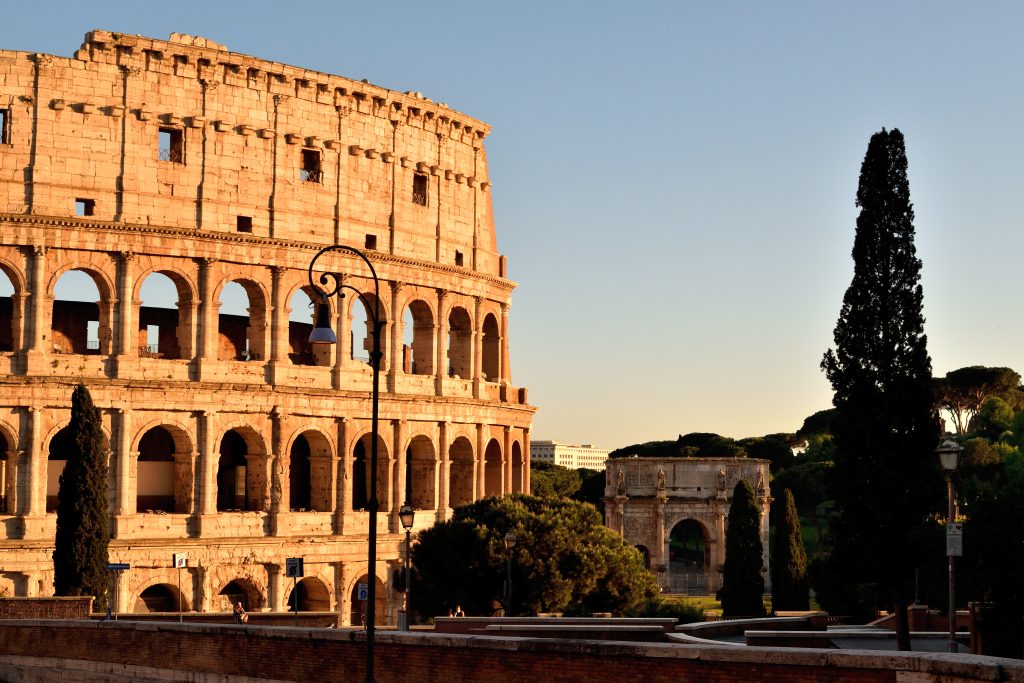
Front view of the Colosseum
Criteria for inclusion in the UNESCO list
UNESCO (United Nations Educational, Scientific and Cultural Organization) awards the title of World Heritage Site to those sites that have exceptional value to all humanity.
To be included on the list, places must meet very strict criteria, including:
- Outstanding universal value: the site must have cultural, historical or natural significance that transcends national boundaries.
- Authenticity and integrity: it must be well preserved and retain original features.
- Historical or artistic significance: it must represent an era, civilization or advancement of humanity.
- Need for protection: it must be subject to protection to ensure its preservation over time.
Some famous examples of UNESCO sites around the world are the Great Wall of China, the Pyramids of Giza, Machu Picchu, and the Palace of Versailles.
In Italy, the country with the most UNESCO sites in the world, we find such treasures as Venice and its lagoon, Pompeii, Florence and, of course, the historic center of Rome, of which the Colosseum is the beating heart.
When was the Colosseum declared a UNESCO heritage site?
The Colosseum was recognized as a World Heritage Site in 1980, along with the entire historic center of Rome, which includes such masterpieces as the Roman Forum, the Pantheon and Piazza Navona.
This important recognition finally made the monument’s inestimable value official, thus granting it greater attention in terms of protection and preservation.
But what does it mean, concretely, to be a UNESCO site?
It means that the Colosseum is considered an asset of all humanity, not just Italy, and that its preservation is an international priority. Indeed, UNESCO, together with Italian institutions, is constantly working to protect it from the wear and tear of time, pollution and the impact of mass tourism.
The best-selling
Colosseum and Roman Forum Ticket + Audio Guide
Fast-track access and audio guide included: explore Colosseum and Roman Forum with one ticket.
from 25€
Full Ticket
Secure payment
Instant confirmation
Mobile ticket
Why is the Colosseum a UNESCO heritage site?

Colosseum seen from the Palatine Hill
There are many reasons why the Colosseum has been listed as a UNESCO site. Let’s look at the main ones.
The historical and cultural importance
It should first be considered that the Colosseum is much more than an ancient arena: it is a symbol of Roman power and culture.
Built between A.D. 70 and 80 at the behest of Emperor Vespasian, the Flavian Amphitheater was the largest amphitheater in the Roman Empire, capable of seating up to 50,000 spectators.
Grandiose spectacles were held here, from gladiatorial fights and hunts with exotic animals to performances of naval battles.
A masterpiece of Roman engineering
Its structure represents an extraordinary engineering feat. Made of concrete, travertine, and brick, the Colosseum boasts an innovative design, with rapid access and outflow systems, rudimentary elev ators to lift animals into the arena, and a complex system of underground hypogea.
Even today, architects and engineers study Roman construction techniques to understand how this marvel has survived for nearly 2,000 years.
The symbol of Rome and Western civilization
When we think of Rome, the first image that comes to mind is indeed the Colosseum. Its profile has become an icon not only of the Italian capital, but of all Western civilization.
It has inspired epic films, novels and works of art, helping to keep the fascination of ancient Rome alive in contemporary culture.
The state of conservation and restoration work
Despite the challenges posed by time, the Colosseum has come down to us in remarkably good condition.
However, its preservation requires constant intervention: over the centuries it has suffered damage from earthquakes, looting, and pollution.
In recent years, major restorations funded by both the Italian state and private individuals (such as the fashion house Tod’s) have made it possible to preserve its beauty and make it even more accessible to the public.
The Colosseum and the protection of world heritage

Renovation of the Colosseum | ID 59713774 | Colosseum © Abxyz | Dreamstime.com
Being a UNESCO site also means being constantly monitored to ensure the survival and integrity of the work.
The main threats facing the Colosseum today are:
- Mass tourism, which can accelerate the deterioration of structures.
- Air pollution, which ruins materials over time.
- Climate change, which makes conservation work more difficult.
Therefore, UNESCO is working together with Italian authorities to protect the monument by limiting the number of visitors and promoting restoration and awareness initiatives.
Frequently asked questions
The Colosseum is part of the UNESCO World Heritage Site for its historical, cultural and architectural value, as well as its importance in human history.
Yes, the Colosseum has been a UNESCO heritage site since 1980, being within the historic center of Rome.
The Colosseum is important because it represents one of the greatest achievements of Roman engineering and an icon of world history.
Rome is home to several sites recognized as UNESCO World Heritage Sites. The main one is the Historic Center of Rome, inscribed in 1980, which includes such iconic monuments as the Colosseum, Roman Forum and Pantheon. In 1990, the site was expanded to include the extraterritorial properties of the Holy See located in the city and the Basilica of St. Paul Outside the Walls.In addition to the Centro Storico, the Latium region is home to other outstanding UNESCO sites:Villa Adriana in Tivoli: a sumptuous residence of Emperor Hadrian, inscribed in 1999. villa d’Este in Tivoli: famous for its Renaissance gardens and fountains, added to the list in 2001. etruscan Necropolis of Cerveteri and Tarquinia: significant evidence of Etruscan civilization, recognized in 2004. it is important to note that although Vatican City is a UNESCO site, it is an independent state and does not fall within the territory of Rome.
Conclusion

Lines of people to enter the Colosseum
Well, here we are at the bottom of this in-depth look at why the Colosseum is a UNESCO World Heritage Site.
In this article we explored why the Colosseum has been declared a UNESCO World Heritage Site, analyzing its historical, cultural and architectural importance.
We discussed UNESCO’s selection criteria and the significance of this recognition.
In addition, we highlighted the current challenges in preserving the monument and the importance of its protection for future generations.
Before concluding, I answered the most frequently asked questions about UNESCO sites in Rome. But if you still have questions, please feel free to ask them in the comments section!
So, are you ready to see the Colosseum for yourself? Don’t waste time in line, book your tickets now and come discover the timeless charm of the Flavian Amphitheater!
The best-selling
Colosseum and Roman Forum Ticket + Audioguide
Fast-track access and audio guide included: explore Colosseum and Roman Forum with one ticket.
from 25€
Full Ticket
Secure payment
Instant confirmation
Mobile ticket
Cover: ID 158224224 © Bumbleedee | Dreamstime.com
