
The gladiators of the Colosseum are among the most iconic figures of ancient Rome.
True heroes of the crowd, they fought in bloody spectacles that mixed skill, strategy, and drama.
But who were the gladiators really? How did the fighting take place? Were they really heroes or would it be better to call them victims?
In this article we will discover together the history of gladiators, their training, weapons and the most epic fights that marked the history of the Colosseum making it the symbol of the eternal city.
Did you know that there were different types of gladiators, each with peculiar weapons, armor and types of fighting? Read on to immerse yourself in the life of Roman gladiators!
ALT! If you would like to visit relive the excitement of the ancient fights with your own eyes, I recommend purchasing your tickets online for the Rome Gladiator School Museum!

Museum of the School of Gladiators Rome: Admission ticket + 2 hours of gladiator education
Get ready for a heated battle as you train like the famous Roman gladiators
from 130 €
Secure payment
Instant confirmation
Mobile ticket
The history of gladiators: origins and significance

Illustration of gladiators in the Colosseum
From funeral ritual to mass spectacle
The earliest traces of gladiatorial combat date back to the Etruscans: it is believed that the Romans may have taken the custom of fighting from this population.
In general, in many pre-Roman cultures , fighting was seen as a valued art: consider that even at the Olympics it was practiced as one of the games that closed the event.
Paintings have been found in Etruscan tombs in Tarquinia showing some kind of gladiatorial fight: it is possible that, initially, even in Roman civilization this kind of fight was connected with funeral ceremonies.
Over time, however, gladiatorial games turned into entertainment events financed by the elite to gain acceptance.
Finally, in the imperial age, no one could compete anymore with the spectacles organized by the emperors: grandiose games that could last for months with the purpose of amusing, entertaining but also political propaganda.
The golden age of gladiators
During the Roman Empire, the Colosseum became the main stage for gladiatorial battles: it was in the great amphitheater that fighters would fight to the death among themselves or against ferocious beasts.
Did you know that the arena of the Colosseum is sprinkled with sand precisely to absorb the blood and clean it more easily?
The first performances held inside the Colosseum were between 80 and 81 AD on the occasion of the inauguration of the amphitheater itself.
Later, emperors used the Colosseum to delight the population on festivals, military triumphs, and imperial celebrations: in addition to amusement for the citizens, they also took over the intention of gaining approval.
During the games, moreover, many spectators placed bets: there was a veritable betting ring. The most valiant gladiators gained fame by winning, as did their owner, and after ten victories they could choose whether to continue facing the arena or become instructors.
Who were the gladiators?

Gladiators in a bas-relief inside the Colosseum | ID 30387887 © Pierre Jean Durieu | Dreamstime.com
Prisoners, slaves and volunteers
In reality, gladiators were forced into a rather cruel life, and almost no one chose to become one.
Mostly, the fighters were slaves or prisoners of war who found themselves forced to fight.
Indeed, refusing to participate would have meant certain death, while those who distinguished themselves by their bravery during battles could earn the freedom granted by some wealthy lord.
However, some free men also enlisted voluntarily, thus hoping to gain glory and rewards: these were people who hoped to turn their lives around, although this was not too common since being a gladiator meant risking one’s life.
The most common cause that prompted free citizens to enlist was the extreme poverty of the unfortunate.
Life in gladiatorial schools
Gladiators were trained in facilities that were sort of schoolhouses called ludi, such as the famous Ludus Magnus near the Colosseum.
This building is the most famous and is regarded as the most famous “gymnasium” for gladiators.
The Ludus Magnus was connected through an underground tunnel to the Colosseum, precisely to improve the performance of the shows.
Gladiator training was really tough and was used to prepare the prisoners and make them fearsome and fierce fighters.
Within the ludi they were taught different fighting techniques, they also practiced exercises with the aim of improving their physical endurance and the use of weapons.
But not only physical exercises: diet was also important! From the sources it is assumed that gladiators were forced to eat an almost vegetarian diet.
There were different types of gladiators, each of whom had their own peculiar way of fighting and specific weapons: however, the most common weapon was a short sword called a gladius, from which the term gladiator is also derived.
During fights at the Colosseum, combatants always faced each other one-on-one, and gladiators always belonged to different types and never to the same one.
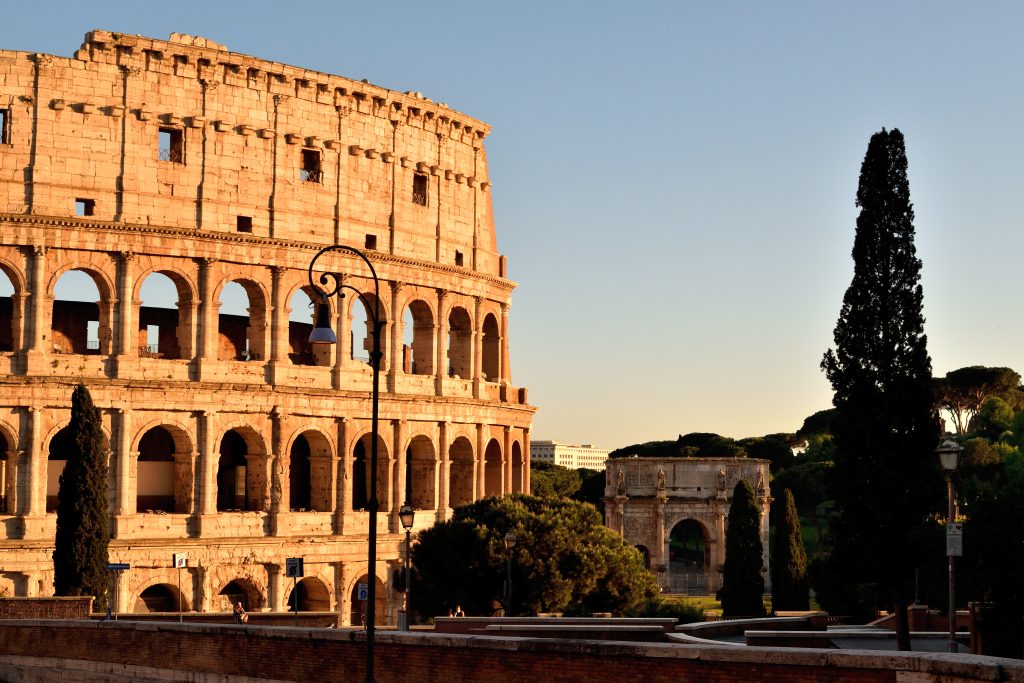
The best-selling
Colosseum and Roman Forum Ticket + Audio Guide
Fast-track access and audio guide included: explore Colosseum and Roman Forum with one ticket.
from 25€
Full Ticket
Secure payment
Instant confirmation
Mobile ticket
Types of gladiators and their weapons

Ave Caesar Morituri te Salutant, painting by Jean-Léon Gérôme
The main types of gladiators
There were several categories of gladiators, but some were favored by spectators and boasted the most valiant fighters. Below are the main categories:
Murmillo
He was a gladiator characterized by physical power and appeared as a veritable colossus.
He was equipped with a large crested helmet and a very large rectangular shield: physical strength was his best weapon!
As an offensive weapon he could possess the gladius or another small sword, and there were few gladiators who could take down this type of fighter with frontal attacks.
Retiarius
The most characteristic weapons in this category were a weighted net and the trident: he used them in combination to throw his opponent off balance and launch attacks from a greater distance.
These gladiators, in fact, lacked heavy armor, but had only light protection, no helmet and no footwear.
Thraex
The name of these warriors comes from Thrace, the region of their origin. They were very agile fighters equipped with a curved sword and a shield smaller than that of the murmillo: the fighting technique consisted of quick attacks beyond the opponent’s protections by aiming at the shoulders and flanks.
Their helmet was distinctive: a curved crest just like those of Thracian soldiers.
Secutor
Their name comes from their fighting characteristic of chasing the opponent.
They had huge shields that protected them completely and a long sword: highly prized were the fights against the retiarius, in fact, the secutor had a helmet without grips precisely to avoid being caught in the net of these gladiators.
Dimacherus
A particular very scenic fighter with only one fighting technique: attack!
Unprotected, he was equipped with two gladii and daggers with which he launched continuous and rapid attacks ensuring a dynamic spectacle for spectators.
The weapons of the gladiators
As you may have read, there were many weapons used by gladiators and they varied according to the type of fighter.
the purpose was to ensure that fights were always different and varied depending on the gladiator and the technique used for the fight.
The most common weapons were short swords(gladii), after which gladiators were named; but also spears, tridents, and daggers.
Also very important were the equipment used for defense and thus shields and armor. Gladiators used shields of different sizes and shapes, also with different decorations, as well as characteristic helmets and more or less heavy covers: the choice changed according to the physical size of the gladiators and their strategy in battle, more defensive or offensive.
In fact, a prisoner was also directed to one school of gladiators or another according to his physical and mental characteristics.
How did the fighting take place?

Fighting with beasts in the Colosseum
Entering the arena and saluting the emperor
The gladiators entered the arena amid applause and roars from the audience: their entrance on the stage was the beginning of the show, and among the games these fights were the most popular!
There was a widespread belief that the fighters as they entered the Colosseum uttered the famous phrase: Ave, Caesar, morituri te salutant! to mark the end to which they were forced.
However, according to some historians it was not really a custom, but happened during the naumachia organized by Claudius, and when he answered them “it is not said” the prisoners understood that they would be pardoned and almost refused to fight.
The fact was an event to the point that it was reported by several historians of the time, but it is not confirmed that this was really the “obligatory” greeting of gladiators.
The rules of combat
The fights were always between two gladiators, belonging to different categories. Each show contemplated several confrontations, each varying in duration from about 10 to 15 minutes and ending only when one of the two gladiators was defeated.
However, contrary to what one might think, defeat did not necessarily mean death: it often happened that one of the two was neutralized and therefore it was up to the organizer of the games to decide the fate of the unfortunate.
The verdict: death or grace?
But was the fate of the defeated gladiator really death? Of course it could happen, but it was not so common.
The organizer of the games, who was often the emperor but could also be a mere backer, had the right to the last word, but he could often seek advice from the crowd, which thus experienced the moment of maximum participation.
The famous thumbs-up or thumbs-down is most likely a historical forgery, however there really were signs that the audience made with their hands to express their preference.
Since procuring and training a gladiator was very expensive, often the defeated was saved, while in case of death the organizer had to compensate the owner of the fighter.
Having fought with honor and courage could mean salvation in the event of defeat, which is why gladiators never gave up and held out stoically until the end of the fights.
The owner of the winner, on the other hand, was entitled to recognition and prizes, while for the gladiator, in the case of many consecutive successes, freedom could also be granted as the ultimate prize.

Gladiator School Museum Rome: Entrance ticket + 2 hours of gladiator training
Get ready for a heated battle as you train like the famous Roman gladiators
from 130 €
Secure payment
Instant confirmation
Mobile ticket
The shows in the Colosseum: beyond the gladiators
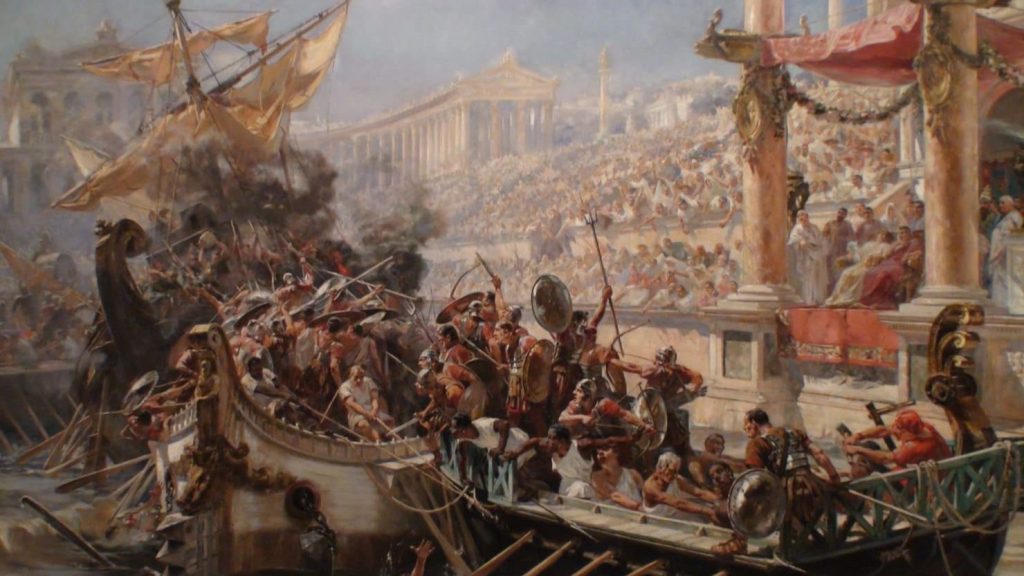
Naumachia, from a painting by Ulpiano Checa
But gladiator fights, although they were the most popular spectacle, were not the only type of organized event. There were also clashes with beasts or naval battles.
Fierce animal fights
Venationes were hunts with exotic beasts such as lions, tigers, and elephants. They were very expensive for the emperor since it was necessary to capture these animals and bring them to Rome, taking into account the many losses caused by the long journeys and different habitats.
Usually these shows took place early in the morning, before the gladiator fights that was the main attraction of the day.
These games were organized mainly in the Roman Forum, Saepta, and Circus Maximus, which provided more opportunities for escapes and chases.
However, the Colosseum was also an important venue for these types of events: its use guaranteed gripping situations, as thanks to its system of trapdoors and hoists, animals would suddenly appear on the arena with unprecedented twists and turns!
These were bloody spectacles that showcased Rome’s power over nature: in most cases all the animals died, but it was possible to see the hunter succumb as well.
Naval battles in the arena (Naumachiae).
The Colosseum could be flooded to simulate naval clashes: in this case it was more of a theatrical performance, where, however, it was not uncommon to see many deaths due to injuries or drownings.
Authentic ships, just on a somewhat reduced scale, and hundreds of combatants recreated real battles from history, and the participants were divided into the two different factions, recognizable by the armor used.
In this case, it was not the gladiators who were the protagonists, but the naumachiarii: they too were prisoners and condemned with no choice.
Frequently asked questions
The gladiators in the Colosseum were almost all prisoners of war and convicts. Sometimes even free men could apply to become gladiators, but it mostly happened to people without any economic resources who hoped for a breakthrough.
The most famous gladiator of all time was probably Spartacus: a Thracian soldier who became a gladiator but managed to escape. His story has been told over the centuries until it was depicted in Kubrick’s iconic film. His revolt freed gladiators and slaves who fought to the end against the power of Rome, which was able to overpower the rebels only after many losses and exploiting many resources.
Gladiators trained in some specific school-casemates known as ludi. Then there were some more renowned gymnasiums, including the one built alongside the Colosseum known as the Ludus Magnus and connected to the amphitheater by an underground tunnel.
The famous film The Gladiator was shot in Italy, England, Malta and Morocco.
Conclusion
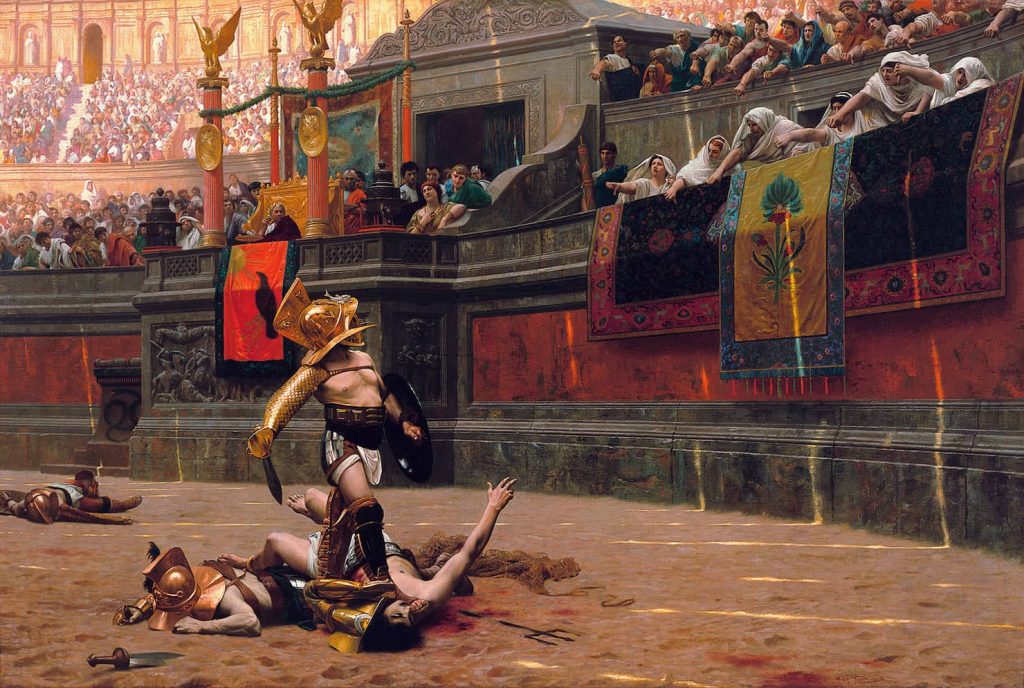
Thumbs Down, painting by Jean-Léon Gérôme
Well, here we are at the end of this in-depth look at the mythical gladiators. In this article we explored together the life of the gladiators of the Colosseum: now you know everything you need to know about these formidable warriors!
I explained where they trained and told you about their training, you found out that there were different types of fighters who specialized using peculiar weapons, armor, and battle characteristics.
You were able to read how the bloody shows of the time took place and what different types existed. Finally, I also told you some historical trivia, before answering the most frequently asked questions inherent to the mighty gladiators.
Have you ever imagined witnessing gladiatorial combat? Write in the comments what you think about these spectacles!
Do you want to relive the excitement of ancient Rome with your own eyes? Do you want to step on the sand of an arena like the one in which Spartacus masterminded his revolt? Buy tickets to the Colosseum to discover the history of gladiators live!
The best-selling
Colosseum and Roman Forum Ticket + Audio Guide
Fast-track access and audio guide included: explore Colosseum and Roman Forum with one ticket.
from 25€
Full Ticket
Secure payment
Instant confirmation
Mobile ticket
