
A short walk from the Colosseum stands the Arch of Constantine, one of the most iconic monumental works of ancient Rome.
A witness to eras and battles, it is a must-see for those visiting the Eternal City.
And did you know that just a few steps from the Colosseum you could admire this work of art?
It must be said that the Arch of Constantine is not only an architectural masterpiece, but also a “collage” of different eras!
Find out its history, where to find it, and how best to visit it.
Read on to explore the history, location, and interesting facts about this extraordinary monument.
A MOMENT! Before we go any further, let me give you some advice: plan your visit stress-free! Buy tickets online for the Colosseum, so you can gain access without queues and take advantage of the time saved to discover the Arch of Constantine as well. Ready to take an unforgettable photo of the amphitheater? Make your reservation well in advance!
The best-selling
Colosseum and Roman Forum Ticket + Audio Guide
Fast-track access and audio guide included: explore Colosseum and Roman Forum with one ticket.
from 25€
Full Ticket
Secure payment
Instant confirmation
Mobile ticket
What is the Arch of Constantine?

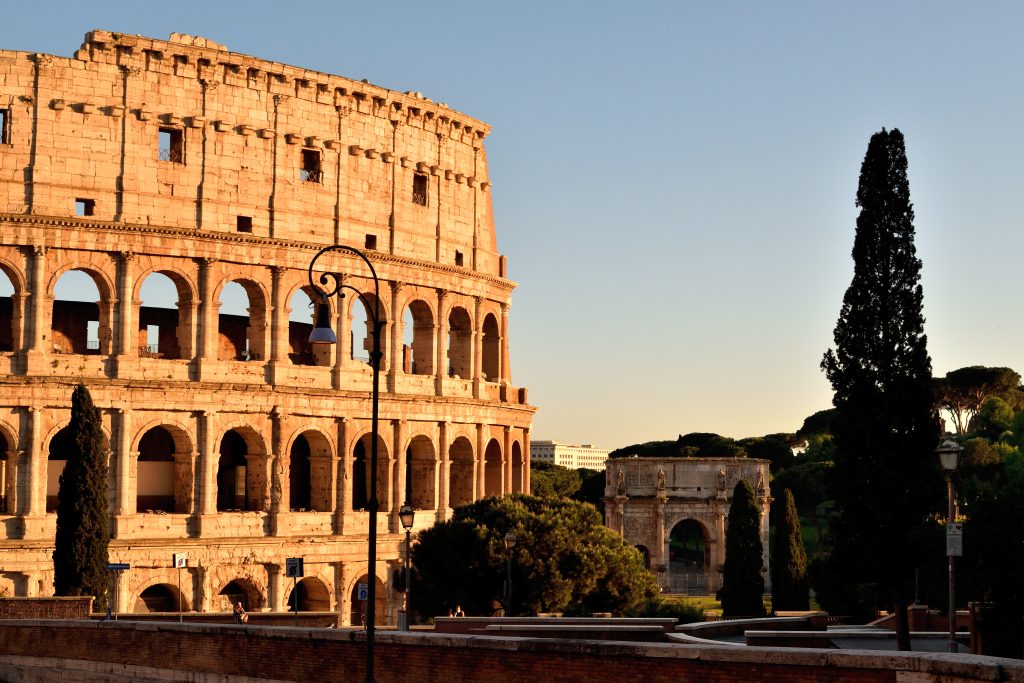
The Arch of Constantine with the Colosseum in the background | ID 187965585 | Arch Of Constantine © Dmitrii Moroz | Dreamstime.com
A tribute to the victory of Constantine
The Arch of Constantine was built in 315 AD to celebrate Constantine’s victory over Maxentius at the Battle of Ponte Milvio fought in October 312 AD.
On the monument you can admire an inscription in which the Senate’s dedication for the Emperor is recorded: the arch was built in honor of the decennalia, or ten years of Constantine’s reign.
This arch is also a symbol of an epochal transition: from ancient pagan Rome to Christianity.
In 325, in fact, Constantine participated in the Council of Nicaea, tying his important figure to the monotheistic religion, and relief depictions of scenes still linked to pagan deities are indeed found in the arch.
Constantine’s empire, it should be noted, is remembered precisely for its freedom of worship, which would later lead to the establishment of Christianity.
21 meters high, 25 meters wide and over 7 deep: it is the largest Roman triumphal arch in existence. If you decide to visit it in person, you cannot help but be fascinated by its majesty!
A mosaic of styles and eras

Detail of the Arch | ID 105420876 | Arch Of Constantine © Ji Chen | Dreamstime.com
The arch is decorated with relief marble slabs made during the Constantinian era: the design is unified, but materials from other imperial monuments were reused to build it as it appears today.
In fact, reliefs from earlier periods, from Trajan, Hadrian, and Marcus Aurelius, are alternated and follow symmetrical patterns.
The result? What you get is a truly fascinating mix of art and imperial propaganda, intended to increase consensus.
Want to know a curiosity? Some bas-reliefs originally represented other Emperors, but were “recycled” for Constantine by changing the features of the protagonists!
All images are connected thematically: the intent is to celebrate the desire for restoration of the Empire implemented by Constantine himself.
The very choice of the arch as a type of monument had this purpose: the arch was, in fact, an ingrained symbol in imperial history as a synonym for triumph and power.
However, this particular one is very unique since it features three arches: the central one is wider and larger while the two side ones are somewhat smaller.
The idea of fusing reliefs and images related to the past always served to give credence to the propaganda design: what the emperor wanted to achieve with this choice was to be able to portray the legitimacy of his power.
In this way, Constantine aimed to show that his rule was rooted in the glory of the past, through the telling in images of the great triumphs and glorious protagonists who made the Roman Empire great.
The best-selling
Colosseum and Roman Forum Ticket + Audio Guide
Fast-track access and audio guide included: explore Colosseum and Roman Forum with one ticket.
from 25€
Full Ticket
Secure payment
Instant confirmation
Mobile ticket
Where it is located and how to get there
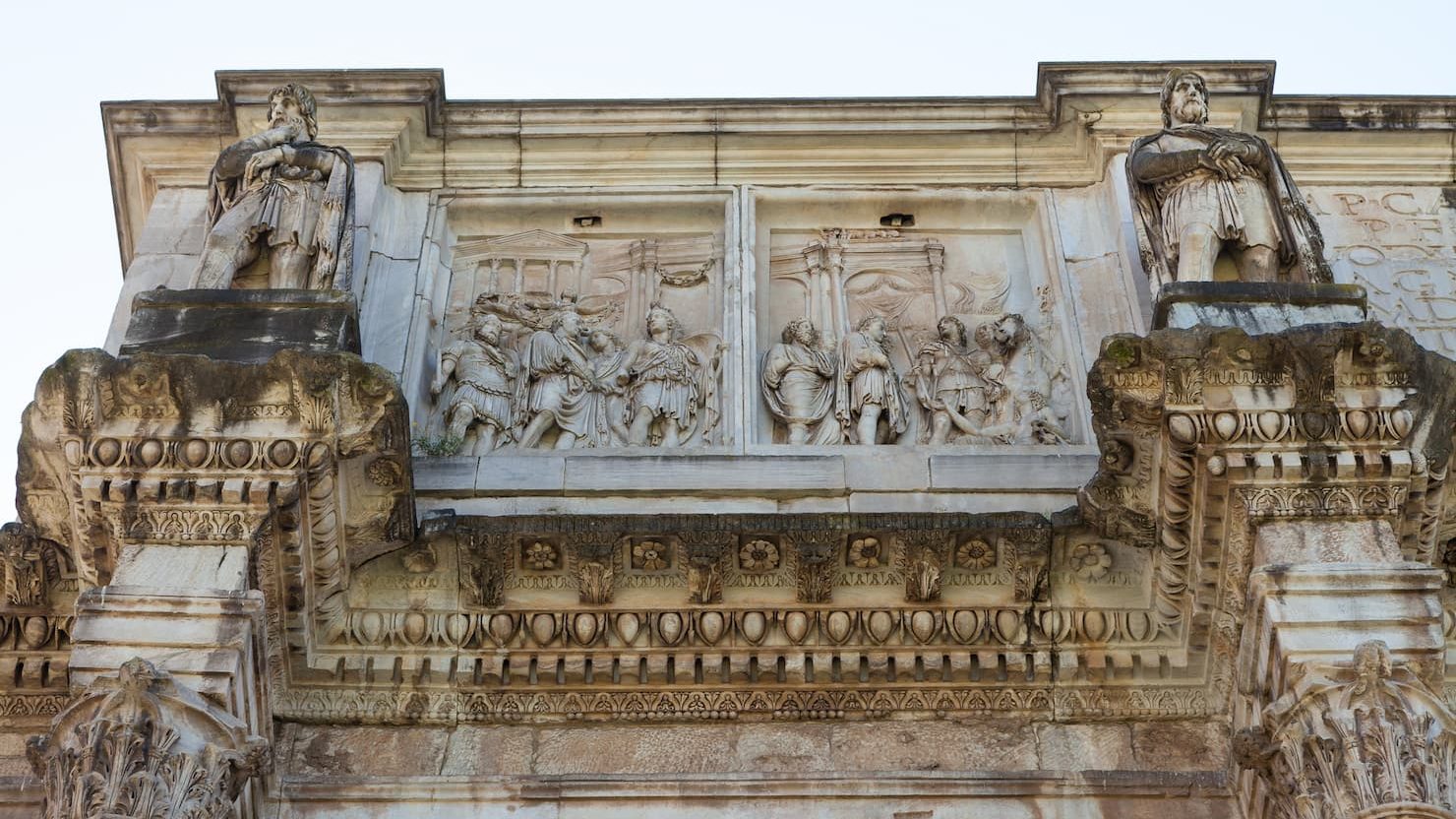
Detail of the Arch | ID 187965566 | Arch Of Constantine © Dmitrii Moroz | Dreamstime.com
Strategic location between Colosseum and Palatine
The Arch of Constantine is located between the Colosseum and the Via Sacra, within walking distance of the Imperial Forums.
It is very easy to spot because of its central location-you can take pictures of both the arch and the Colosseum in one shot!
Its location makes it ideal for planning a comprehensive visit to the main monuments located in the center of Rome: in a single day you can visit many historical sites of the city, moving comfortably on foot, walking through history, maybe on a beautiful sunny day!
How to get there
Getting there is a breeze! Just follow the same directions to the Colosseum, and if you wish, you can read our dedicated article for all the detailed information.
In any case, below I leave you with some practical directions:
Metro: Line B, Colosseum stop. Once you get off just cross the street and you will find the arch on your right.
Bus: Lines 51, 75, 85, 87, 118. They all stop near the place of interest and with a very few minutes walk (sometimes seconds!) you will reach the arch.
Walking: Ideal for a stroll among the monuments of the historic center. When the sun warms the streets of Rome, walking in this area is a real pleasure!
How best to visit it
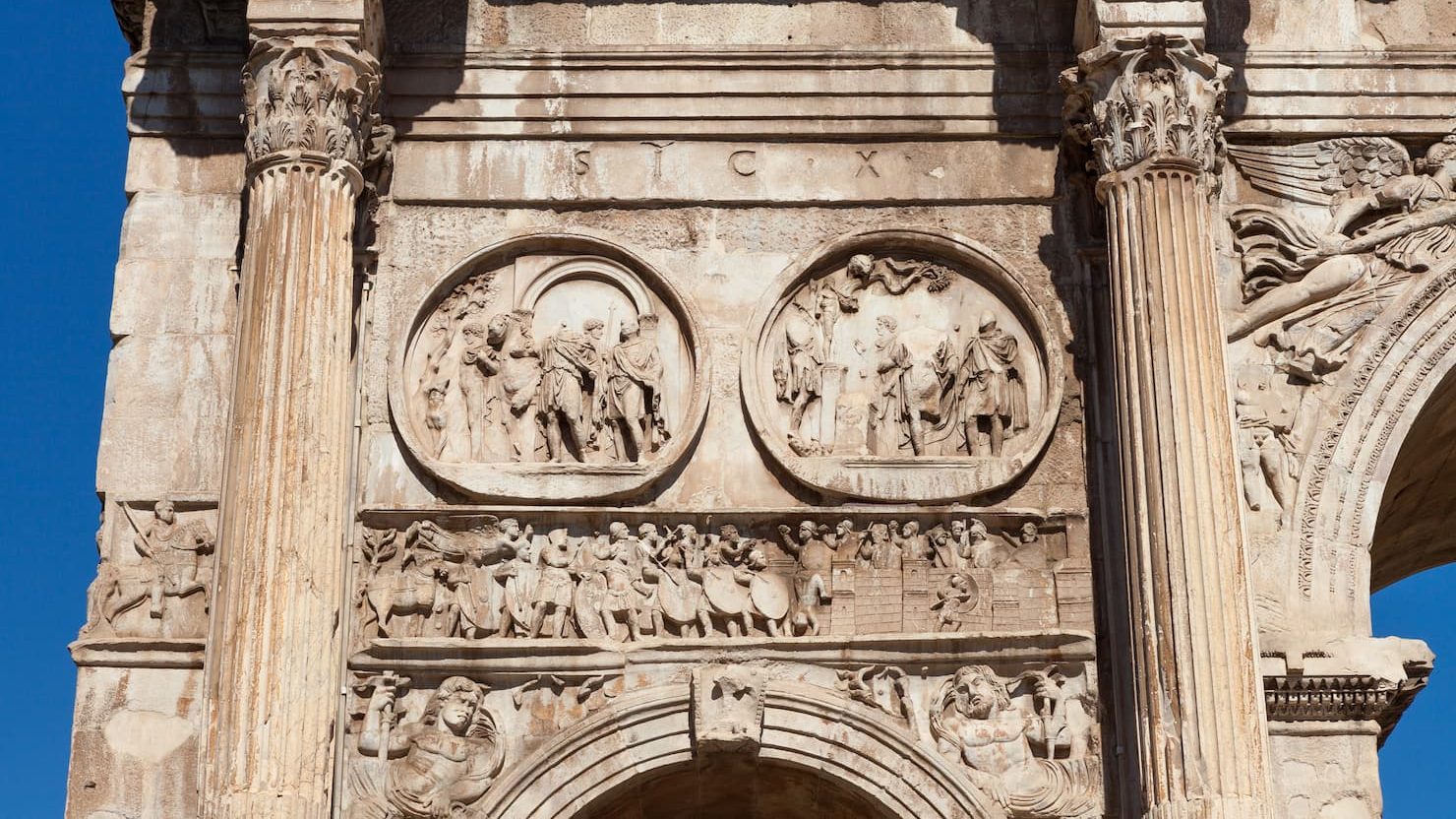
Detail of the Arch | ID 187965780 | Arch Of Constantine © Dmitrii Moroz | Dreamstime.com
Is it possible to enter the Arch of Constantine?
No, the arch is only visible from the outside, but it is easily accessible to best admire its details. You will be able to walk around the arch 360 degrees to view it from all angles and follow the various reliefs that adorn it.
Its location makes it perfect for taking spectacular photos, especially at sunset. Many tourists take advantage of its location to photograph both the arch and the Colosseum together, giving themselves a splendid shot as a souvenir!
What to see nearby?
There are many attractions you will find in the immediate vicinity of the Arch of Constantine. Let’s look at some of them:
Colosseum
Just a few meters away, you can find the world’s most famous amphitheater. There is no visitor who has not admired both: if you’ve come this far to see the Arch, you can’t miss the Colosseum, and vice versa!
Roman Forum and Palatine
The political and religious heart of ancient Rome is just a stone’s throw from the Arch! Many visitors purchase the combined ticket that allows queue-free access to the Colosseum, Forum and Palatine, then enjoy the Arch at the end of the tour!
Via dei Fori Imperiali
Not just any ordinary street walk, but a walk through history, among the remnants of Roman greatness: did you know that the forums were built by different emperors to give prestige to their rule?
Most Frequently Asked Questions
The Arch of Constantine was built with the agreement of the Senate: it stands in honor of Constantine and his ten-year reign. The arch was meant to celebrate the emperor’s victory over Maxentius.
The oldest arch in Rome is that of Titus, erected between AD 81 and 96. However, there is that of Germanicus, which appears to be older but is located in France.
The Arch of Constantine is considered a museum of official Roman sculpture because it is filled with different reliefs on marble slabs, which come from different imperial monuments. On the arch, in fact, one can see different scenes related to the history and characters of the empire rendered by a combination of sculpture and architecture from different eras such as that of Trajan, Hadrian, and Commodus.
The fornixes are the openings within the arch, and this one of Constantine is characterized precisely by having three. The central fornix is larger than the other two and is embellished with splendid relief decoration on each side. Above the minor arches, on the other hand, we find depictions of the exploits of Constantine, who appears victorious against Maxentius.
Conclusion
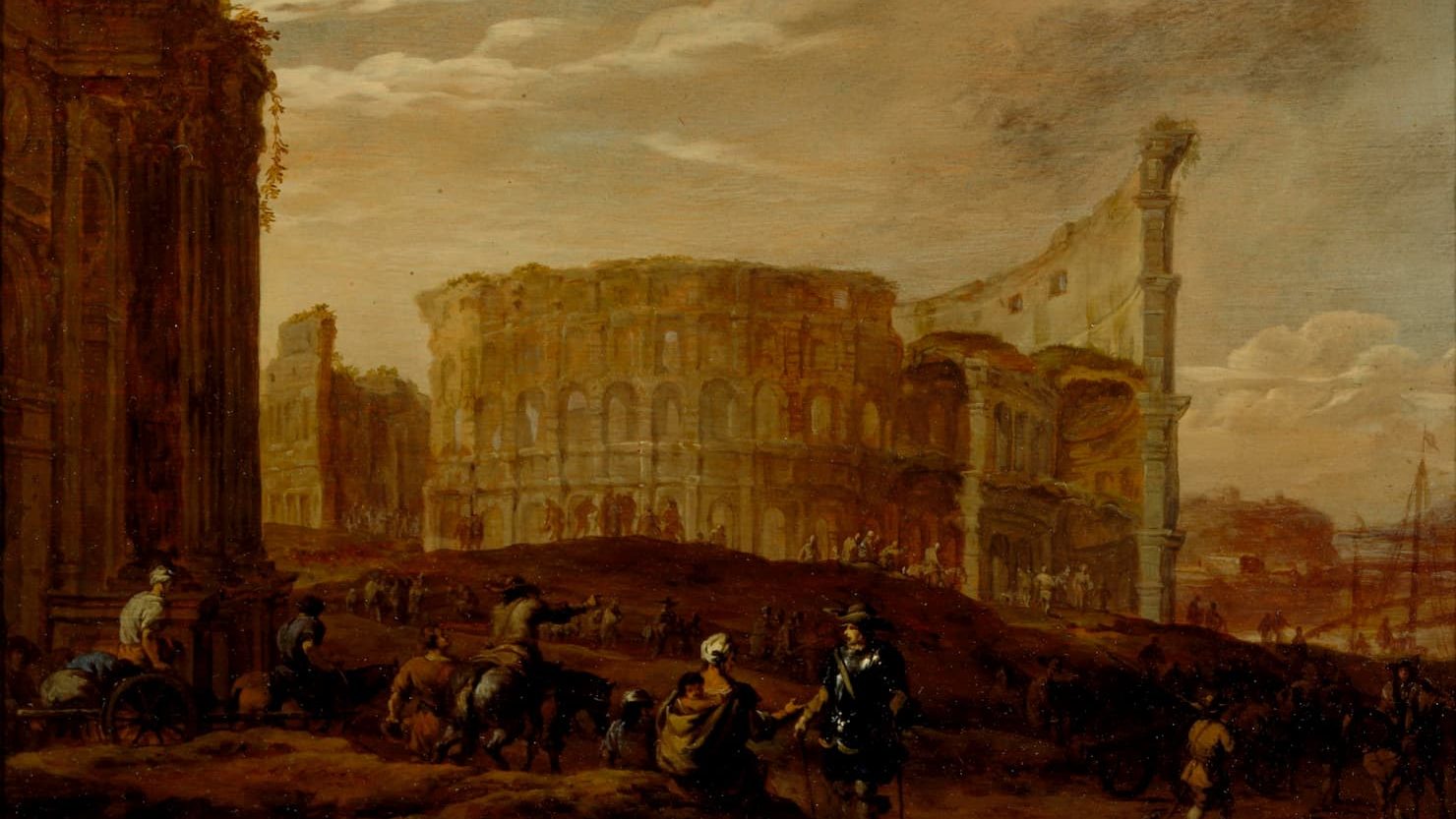
Arch of Constantine and Colosseum painted by Jacob van der Ulft
Here we have come to the conclusion of this article on the Arch of Constantine. We discovered together what the Arch of Constantine is, its history and significance, as well as where it is located and how best to visit it.
I provided you with trivia, practical tips, and photographic suggestions for a wonderful souvenir photo! You were able to read what its special features are, from its three archways to the presence of reliefs “recovered” from other monuments belonging to different periods.
Now you also know the secret of the figures in these marble reliefs to which, in some cases, the features were changed in order to depict Constantine.
And you also know that this arch had a propaganda purpose and is considered a veritable museum of official Roman sculpture.
Finally, I have answered the most common questions inherent to the arch, but if you still have doubts leave us a comment below.
How about you? Have you seen the Arch of Constantine yet? Tell us about your experience in the comments!
And, be sure to book your tickets to the Colosseum well in advance. Plan your visit in time and get ready for a full experience among the monuments of Rome!
The best-selling
Colosseum and Roman Forum Ticket + Audio Guide
Fast-track access and audio guide included: explore Colosseum and Roman Forum with one ticket.
from 25€
Full Ticket
Secure payment
Instant confirmation
Mobile ticket
Cover: ID 187965585 | Arch Of Constantine © Dmitrii Moroz | Dreamstime.com
