
Did you know that beneath the Colosseum arena lurked a secret world of passageways, animal cages and extraordinary machinery?
The dungeons, called hypogea, were the beating heart of the spectacles, where gladiators and beasts awaited their entry into the arena.
Imagine walking through the places where gladiators awaited their fate and beasts were transported to the surface with ingenious hoists.
Today you can discover these secrets with an exclusive tour of the Colosseum’s underground passages!
In this article you will discover the history, structure and reconstruction of the hypogeum, as well as all the information you need to buy the best tickets and enjoy a unique experience.
I will also provide you with some interesting trivia: did you know that originally the dungeons were not there, which made it possible to organize naumachia, the impressive naval battles? It was in fact Domitian who built them at a later time.
ALT! We would like to warn you: the dungeons of the Flavian Aphitheater are a very exclusive attraction. Book your Colosseum underground tour now and gain access to a restricted area that few visitors have the chance to explore!
Colosseum, Arena, Underground, Forum and Palatine + Guided Tour
Discover every secret of the world’s most famous amphitheater, then explore Forum and Palatine with an expert guide.
from €71
Secure payment
Instant confirmation
Mobile ticket
History of the Underground of the Colosseum
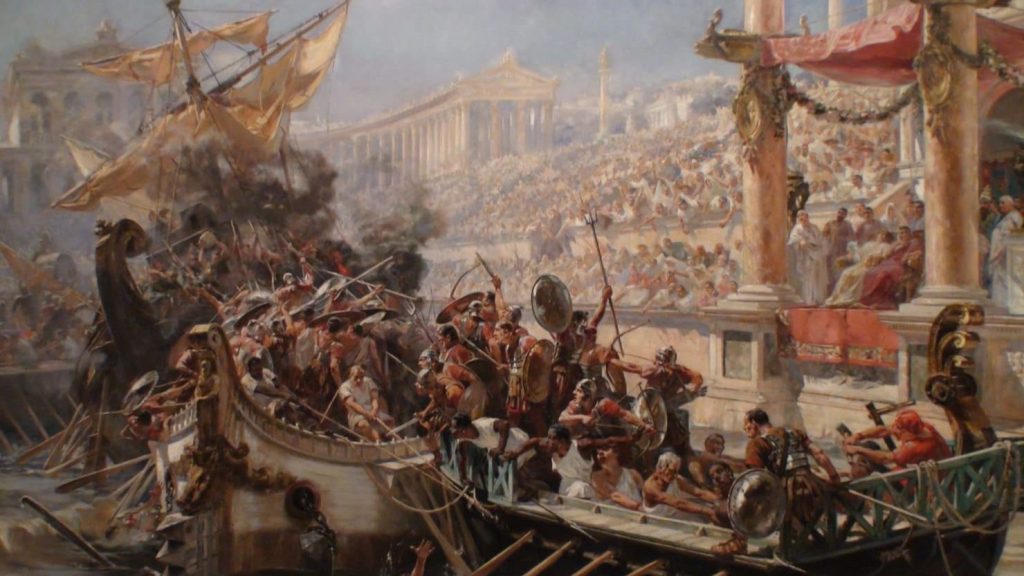
Naumachia, from a painting by Ulpianus Checa
The dungeons, initially, were not present in the Colosseum.
They were built at a later time by Emperor Domitian: from that time on, the spectacular naval battles could no longer be organized.
In fact, the dungeons were built under the arena, and flooding it would have meant destroying them.
The hypogeum consisted of a system of corridors, rooms, and trapdoors used for running the shows.
They functioned as a real backstage, with cages for animals, dressing rooms for gladiators, and hoists for stage sets and stage traps: beasts would suddenly appear on the stage, creating amazement and excitement among the spectators.
After the fall of the Roman Empire, the dungeons were abandoned and partially buried until they were found.
In 1811, the earthworks of the arena began. The following years were crucial for the Colosseum, which was the focus of works and major excavations that today allow us to visit it as it appears!
How was the hypogeum structured?

Underground and Arena of the Colosseum
The underground labyrinth
The major axis divided the area into two semicircles, traversed by curvilinear corridors.
The rooms along the perimeter wall are thought to have been used to hold animals and to allow gladiators to prepare while waiting to enter the arena.
An internal system of tunnels connected the Colosseum’s basement to two different structures: a tunnel to the east led to the Ludus Magnus, while the one to the west led to the Temple of Venus and Rome and was probably used to set up stage sets.
Along the north and south axis, however, two other tunnels led toward Colle Oppio and in the direction of the Caelian, respectively.
Finally, a fifth gallery led to the emperor’s box, excavated during the time of Domitian, and probably led to some imperial palace: it is known by the name “Commodus’ passage” since this is where they made an attempt on the emperor’s life.
Below the 4 main tunnels is a system of as many hydraulic conduits used to dispose of rainwater and latrine drains.
Other large hydraulic conduits have been found, but they are too large to be used for the same purpose: they are believed to have been used to feed Nero ‘s artificial lake that stood right where the Colosseum was built.
Colosseum, Arena, Underground, Forum and Palatine + Guided Tour
Discover every secret of the world’s most famous amphitheater, then explore Forum and Palatine with an expert guide.
from €71
Secure payment
Instant confirmation
Mobile ticket
Cages and housing for animals and gladiators
There were many beasts that the ancient Romans were able to admire during the games at the Colosseum.
Not only fierce animals such as lions and tigers, but there were many that came to the amphitheater: gazelles, antelopes, bears, crocodiles, rhinos, hippos, giraffes, ostriches, hyenas, and panthers.
The animals came to Rome from conquered places, from Egypt, from Asia: the cost of bringing them to Rome was exorbitant, considering also that many died because of the long journey and unsuitable climatic conditions.
The animals were kept inside cages in the dungeon and only at the appropriate time did they appear in the arena.

Daniel in the lions’ den, painting by Rubens
A system of hoists would raise the cages to the necessary level and then they would open: the effect was truly scenic as the audience would see the beasts suddenly appear.
The gladiators, like the beasts, also waited here for their moment to make their entrance on stage: they, however, after waiting in special rooms, entered the arena through the gladiator gate, located on the eastern side of the Colosseum.
It was this gateway that connected the hypogeum to the floor of the arena from which the valiant fighters appeared.
Machinery and hoists
Roman engineers had designed a system of elevators and trapdoors to make animals and fighters appear from nowhere. Mechanisms similar to those in the theater made the shows even more amazing.
The hoists were powered by a winch lifting system: using ropes, ropes, bearings, and other equipment, the ancient Romans were able to lift cabins-cages weighing more than 300 pounds!
The devices worked by exploiting human labor: eight people were placed at two different levels allowed the cabin to rise about 7 meters to the level of the arena.
Once at the necessary level, a trapdoor opened allowing access to the arena via a sloping walkway.
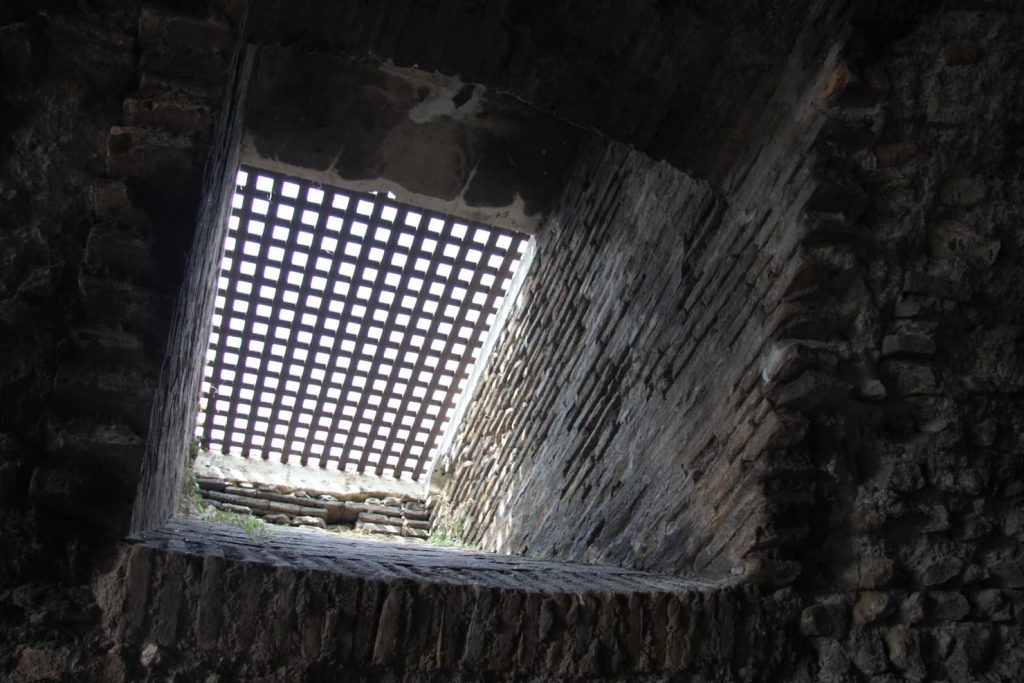
In addition to the hoists, there were also about 20 moving platforms. They were lowered through grooves cut into the walls: you can still admire the marks on the stone today!
Once they reached the bottom of the dungeons, stage sets were mounted on them and then lifted up to the arena floor.
For the audience they consisted of a major surprise: this was how they saw parts of the stage set suddenly appear. These raised platforms also raised by the use of ropes and winches.
Modern reconstruction of the basement
Under the arena | ID46746415 | Colosseum © Merlin1812 | Dreamstime.com
Excavation and restoration
The hypogeum has undergone numerous restorations to allow it to be visited. The first restorations were initiated by the Napoleonic government and later by the Papal State, which aimed to end the deterioration of the structures.
It was in 1811 that the Colosseum underwent major works: the earthworks of the arena began!
The work was entrusted to the Ligurian Carlo Fea and continued for three years, that is, until it had to come to an abrupt halt due to flooding of the basement.
Archaeologists, during their work, discovered traces of the hoisting systems and paths used by the gladiators: the base of the winch attachments in the “dock” is easily admirable today for those who visit the dungeons.
Opening to the public
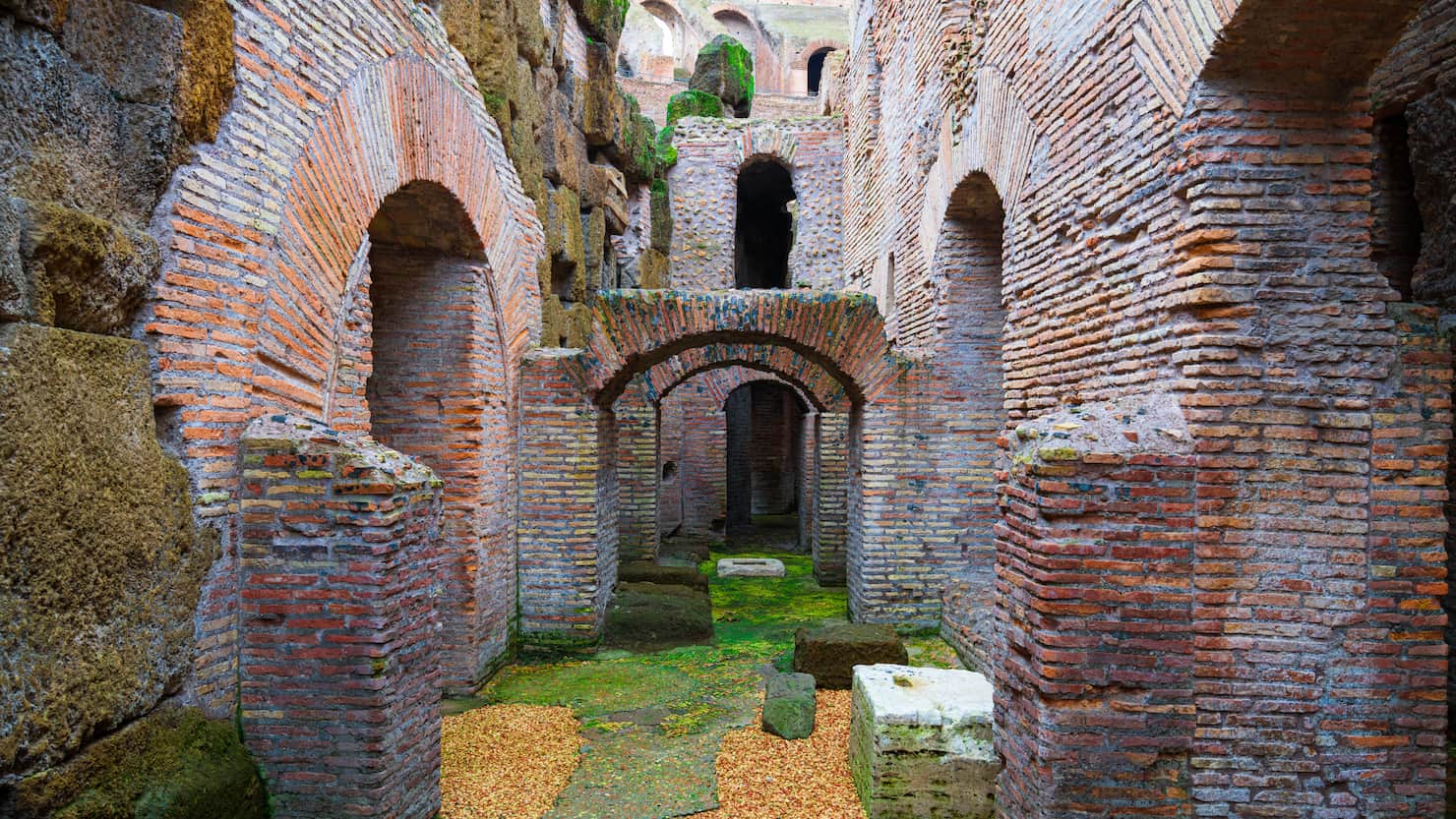
Underground of the Colosseum | ID 256339538 | Colosseum © Sean Pavone | Dreamstime.com
Only since 2010 has it been possible to visit the undergrounds through guided tours.
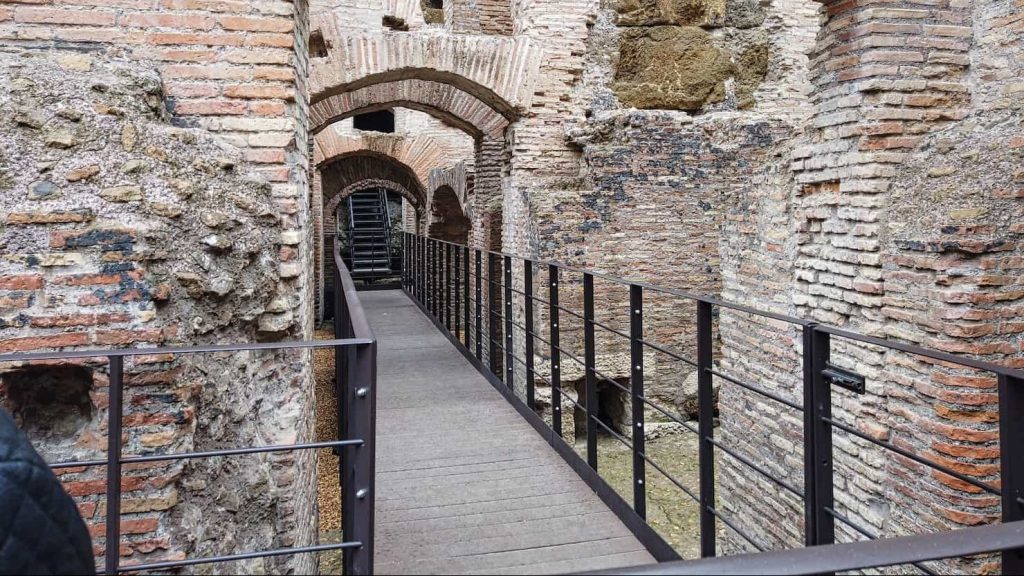
A modern walkway allows visitors to walk over the ancient tunnel system and observe the area up close.
The masonry, dating from the first century AD with additions from the next two centuries, is well preserved.
The excellent state of preservation is due to the burying during the 5th century of the dungeons, which have thus been preserved.
While visiting the dungeons it is possible to admire the bronze attachments in which the winches were embedded. It is also possible to admire a channeling for water runoff.
How to visit the underground passages of the Colosseum: tickets and tours
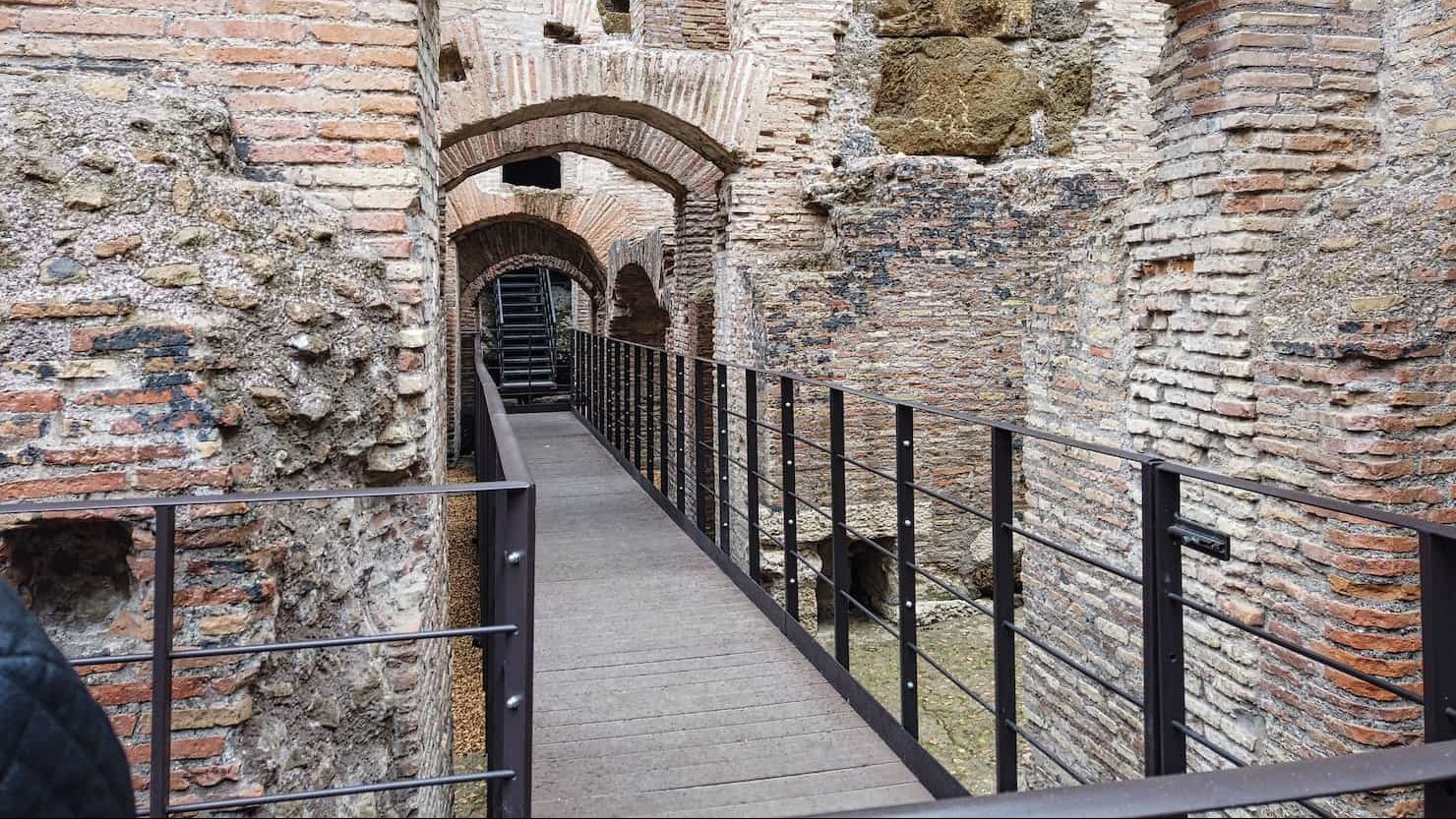
Footbridge in the basement of the Colosseum | ID 266998206 | Colosseum © Wirestock | Dreamstime.com
The underground passages of the Colosseum are not accessible with a standard ticket, but only by guided tours.
There are tickets that include a complete exploration of the Colosseum, below I present the best one:
This ticket includes Colosseum, Arena, Underground, Forum and Palatine.
Accompanied by an experienced guide, you will be entitled to access the Underground and Arena, as well as being able to visit the entire Colosseum and also the Forum and Palatine. The languages on this tour are English and Spanish.
You will be able to access the attractions without having to queue at the ticket offices, and an expert guide will give you all the historical information for a complete and exciting tour through both visitable rings of the amphitheater, the arena and its underground. If you would like to purchase it, just click on this link: the price is really convenient as it starts from 71 euros per person.
Frequently asked questions
The underground passages of the Colosseum were a series of corridors and tunnels excavated for the purpose of organizing and running shows in the amphitheater. It was here that gladiators were prepared and ferocious animals were kept in cages. The dungeons were, in addition, connected to the Ludus Magnus, the “gymnasium” of the gladiators, by a long tunnel, while on the other side a tunnel led to the temple of Venus and Rome.
To visit the dungeons you must necessarily book a guided tour that includes them in the itinerary. There are various packages, but the most convenient is the one you will find at this link.
Part of the Claudian Aqueduct, which was located on the Caelian Hill and allowed the amphitheater to be flooded in a very short time, was used to fill the Colosseum.
Inside the Colosseum you will be able to visit part of the arena, the dungeons, the rings of the Colosseum with part of the steps.
Conclusion
Here we have finally explored together the history and structure of the Colosseum’s dungeons, discovering their fundamental role in the spectacles of Roman times.
Now you know that there were trap doors and hoists to bring gladiators, beasts and parts of the sets onto the arena.
I have also provided you with information about their reconstruction and recovery of parts following restoration.
Finally, I have advised you on how to book an exclusive visit and answered the most common questions inherent in the subject.
Should you have any other doubts, please do not hesitate to contact us by leaving a comment below, or let us know what you think and if you would like to discover this secret place in the Colosseum. Have you already visited the hypogeum? Tell us about it in the comments!
And if you haven’t yet, don’t miss the opportunity for a unique experience: book your ticket now for the Colosseum’s underground and discover the secrets hidden under the arena!
Colosseum, Arena, Underground, Forum and Palatine + Guided Tour
Discover every secret of the world’s most famous amphitheater, then explore Forum and Palatine with an expert guide.
from €71
Secure payment
Instant confirmation
Mobile ticket
Cover: ID 259003070 | Colosseum © Ionut Dragos Sandu | Dreamstime.com
