
The Colosseum is one of the most iconic symbols of Rome and the entire world.
Born as an amphitheater for grandiose spectacles, it has spanned centuries of history, transforming itself several times until today it has become one of the most visited tourist attractions on the planet-think of it being listed among the 7 Wonders of the Modern World and, since 1980, a UNESCO World Heritage Site!
But how did the Colosseum come into being? What events marked its history? And how has it managed to endure to the present day?
The Flavian amphitheater has gone through many highlights and different historical eras that have helped make it as we see it today.
Do you therefore wish to know more? Read on then, because in this guide you will discover the fascinating history of the Colosseum, from its origins to modern times!
ALT! If knowing the history of the Colosseum is not enough for you and you want to see Rome’s most famous monument with your own eyes, hurry up! You should know that the Flavian Amphitheater is one of the most visited attractions in the world. By booking online, you can get priority admissions without standing in line and many other benefits!
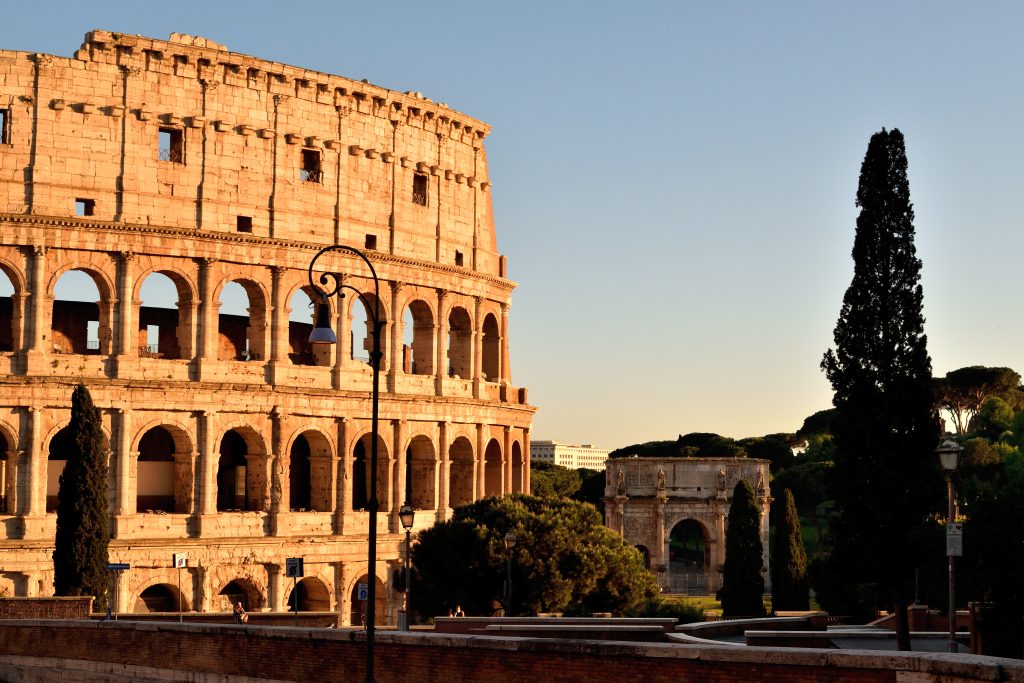
The best-selling
Colosseum and Roman Forum Ticket + Audio Guide
Fast-track access and audio guide included: explore Colosseum and Roman Forum with one ticket.
from 25€
Full Ticket
Secure payment
Instant confirmation
Mobile ticket
The history of the construction of the Colosseum

Interior of the Colosseum, painted by Thomas Cole, 1832
Who built the Colosseum and why?
Construction of the Colosseum began in 70 AD at the behest of Emperor Vespasian of the Flavian dynasty.
The economic resources for its construction were drawn from the spoils of the sack of Jerusalem and provincial taxes.
Where we see the monument today, before its construction there was an artificial lake that Nero wanted to embellish his own residence, the Domus Aurea. (If you want to learn more about the Domus Aurea, I recommend our article on monuments near the Colosseum)
Vespasian, in fact, wanted to return to the Roman people this part of the territory that the tyrant had appropriated, and it was one of the many activities related to the damnatio memoriae initiated against Nero.
However, the amphitheater was completed by Titus, who had the third and fourth tiers of seats added and inaugurated it in 80 CE, giving Rome its first great amphitheater.
Work was completed by Vespasian’s second son Domitian, who among other changes also had the basement built below the arena: this caused an end to the naval battles held inside the Colosseum.
Structure and architectural innovations
It is estimated that the Colosseum had a capacity of more than 50,000 spectators, although according to some historians it could have reached even higher numbers.
The amphitheater was composed of four different architectural orders: the first are each composed of 80 arches, while in the last the subdivision was achieved by windows that interspersed several squares.
The basement of the Colosseum was a kind of “backstage“: it was here that gladiators prepared for battle and could get there through a tunnel connected to the Ludus Magnus. (If you want to learn more about the Ludus Magnus, I recommend our article Monuments Near the Colosseum: What to See Nearby?)
It was always in the dungeons that the ferocious animals were found, which were then made to climb into the arena through a system of trap doors and hoists, which was also exploited to make surprise appearances of parts of the stage set.
Did you know that the Colosseum had a velarium to protect spectators from the sun?
The velarium was a kind of modern marquee that allowed those in attendance to enjoy the performances to the fullest.
Although historians are certain of its existence through various sources, they have some doubts as to how it could have been supported: the most accepted hypothesis is that the velarium was supported by masonry and wooden supports inserted in the fourth ring.
The best-selling ever
Colosseum and Roman Forum ticket + Audioguide
Fast-track access and audio guide included: explore Colosseum and Roman Forum with one ticket.
from 25€
Full Ticket
Secure payment
Instant confirmation
Mobile ticket
Colosseum shows

Gladiators in a bas-relief inside the Colosseum | ID 30387887 © Pierre Jean Durieu | Dreamstime.com
Gladiators and epic battles
The name of the infamous gladiators comes from the weapon they used: the gladius.
The fights in which they took part are known as munera, often organized by wealthy families to honor a deceased relative.
Then, in imperial times, these spectacles converged into the Ludi, or games “sponsored” by emperors for their own and the people’s enjoyment, of which the Colosseum became the symbol.
Thus we began to see bloody gladiator fights and even duels with ferocious beasts.
The goal was to make the fights last as long as possible to get maximum audience involvement-did you know that’ s why the arena is oval?
In fact, this geometric shape allowed every part of the arena to be visible without blind spots; it also prevented the gladiator from remaining “cornered.”
The audience cheered and enjoyed themselves; the games were an important moment in Roman society, and it is no accident that Juvenal‘s saying, “panem et circenses,” became so famous.
The combatants fell into different categories depending on the assault techniques and weapons used, choices that involved different types of training.
The pairs of gladiators facing each other were always part of different categories, and the most beloved moment of the shows consisted of the final part, in which the winner asked the audience what fate to inflict on the defeated.
The spectators, through typical hand gestures, proposed what fate was to befall the defeated fighter, but it was the emperor who had the final say.
The death of a gladiator was a substantial expense for the emperor, as well as for his “owner,” and it meant losing years of training in an instant. That is why executions were actually not so frequent. The life of a gladiator was very hard: in the vast majority of cases, gladiators were slaves forced into deadly fights and a strenuous life. The only hope for them was to win their freedom if noticed by a patrician for extreme courage and strength.
The Naumachiae
The Naumachies were the incredible naval battles simulated inside the amphitheater. The first one in history is believed to have been organized by Julius Caesar who, in 46 B.C., had a basin dug in the Campus Martius, near the Tiber, to celebrate his triumphs.
The peculiarity of these battles was that each fleet represented a people famous for their maritime power: for example, in Caesar’s, Egyptians and Phoenicians were represented.
Amphitheaters were used to organize Naumachiae: by flooding the arena by a few inches, the ships could float and thus became the setting for these performances.
Flooding was achieved by means of special pipelines, but the Colosseum’s system has not been found intact. However, its use has been hypothesized by observing two other Roman amphitheaters: that of Verona and that of Mérida.
According to sources, the last naumachia organized inside the Colosseum was that of Domitian in 85 A.D., considering that he then had the basement built, making this type of spectacle effectively impossible.
The decline
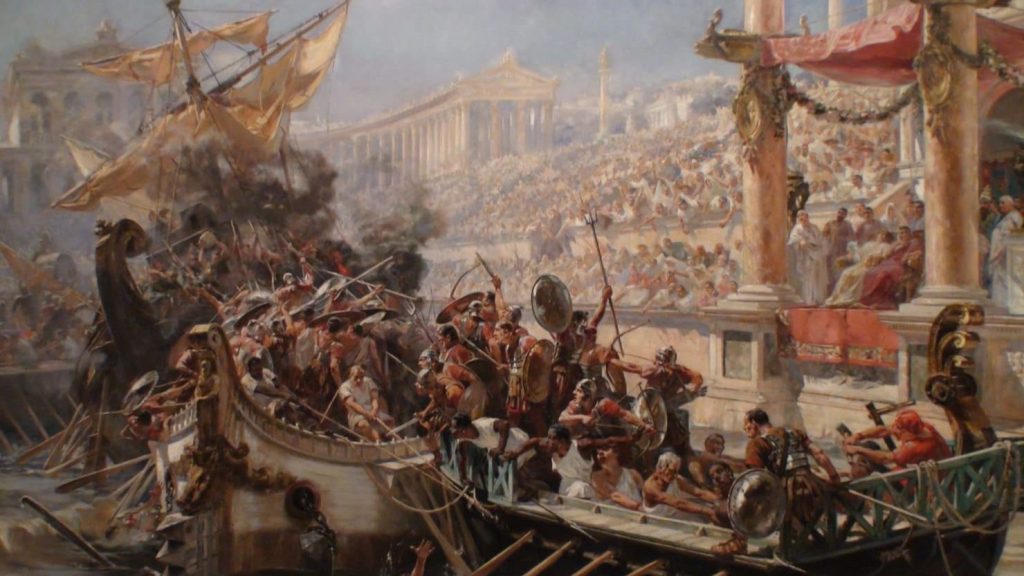
An example of Naumachia, from a painting by Ulpiano Checa (1894)
From symbol of empire to decay
After the fall of the Roman Empire, the Colosseum stopped hosting performances and was soon abandoned.
In the 6th century it was used as a burial area and later as a fortress.
The Colosseum was also used as a shelter and sometimes as areas in which to stable livestock: the amphitheater verteated in a state of total abandonment.
In the 13th century the Frangipane family built a palace-fortress inside the Colosseum, complete with a wooden walkway for patrols.
During the Middle Ages, moreover, the Colosseum became a veritable quarry for materials: if you visit the monument, you will find “pierced” stone blocks, this is because the metal grapples contained within them were recovered.
Later, during the 15th and 16th centuries, travertine and marble blocks were also taken and used to build other buildings.
Earthquakes and structural damage
During the Middle Ages a number of violent earthquakes destroyed much of the structure: in 1349 the south side collapsed. Other earthquakes in later centuries caused other parts of the Colosseum to collapse: fallen materials were often taken for reuse, such as in 1634, when blocks from the amphitheater were used to build Palazzo Barberini, and in 1703 to build the port of Ripetta.
The Colosseum today

Front view of the Colosseum today
From ruin to cultural symbol
From 1675 the revival of the Colosseum began: it was considered a sacred place in memory of Christian martyrs. And in 1749 Pope Benedict XIV declared it a church consecrated to Christ.
From the 19th century the great restorations of the Colosseum directed by Carlo Fea began. Thus began the construction of architectural works designed to ensure the stability of the monument.
Collapsed parts are also reconstructed in a manner faithful to the original, and even during the Fascist period of the 20th century the Colosseum underwent restoration work desired by Mussolini between 1938 and 1939.
The latest work, however, is only a few years old: in 2018, in which archaeologists, restorers, architects, engineers, construction workers and printers participated, all under the supervision of the Colosseum Archaeological Park.
In 1980 the Colosseum became a UNESCO World Heritage Site, and in 2007 it was listed among the Seven Wonders of the Modern World.
A symbol of Rome and Italy, it has also been depicted on Italy’s 5-cent coin since 2002.
A small curiosity: the origin of the name
And do you know why the Colosseum is called that? Near the Colosseum stood a huge statue of Nero. A bronze Colossus from which the amphitheater is thought to have inherited its name.
After the tyrant’s death, the statue was worked on so that it depicted the Sun god and then, in 126 A.D. it was moved because, where it was placed, Augustus wanted to build the temple of Venus and Rome and it was therefore torn down in the imperial age. In the 14th century, a judge claimed that the Colosseum was the principal pagan place in the world and that it was even the place where seven lovers of the devil gathered: Pope Benedict XIV thus had the Colosseum exorcised and then consecrated.
Frequently asked questions
Work on the construction of the Colosseum began in 70 AD under Emperor Vespasian of the Flavian dynasty and was completed by his descendants Titus and Domitian. Large spectacles organized for the populace were held inside: reproductions of naval battles, epic scenes, and gladiator fights were held inside the amphitheater. Following the collapse of the Western Roman Empire, the Colosseum was gradually abandoned and then used for various purposes: the material with which it was built was reused in other construction sites, the covered spaces used as stables or dwellings, and in the Middle Ages part of the Colosseum was even used as a palace-fortress by the Frangipane family. Various earthquakes over the centuries caused several parts of the amphitheater to collapse, so beginning in the 19th century major restoration work was undertaken. In 1980 the Colosseum became a UNESCO World Heritage Site, and in 2007 it became one of the wonders of the modern world.
1) The construction of the Colosseum lasted about 10 years and tens of thousands of slaves were used;2) It was built on the site of an artificial lake: originally desired by Nero to beautify his home, it was made to dry up upon the tyrant’s death;3) The Colosseum originally did not have this name: it was called the Flavian Amphitheater in honor of the dynasty that built it;4) The games could last as long as 100 days;5) originally the Colosseum was covered with marble, but the material was taken and used for other constructions;6) the Colosseum had a marquee that covered its spectators from the sun and rain: historians do not agree on how it worked, but it seems that the velarium was retractable and during performances it was operated as needed;7) After the fall of the Western Roman Empire, the Colosseum fell into disgrace: gradually abandoned for its original purposes, it became a place of many uses. Some, in fact, built shelters and stables inside it, and it was also used as a burial place;8) Besides marble, the other material widely used to build the Colosseum was travertine, quarried about 32 km away in Tivoli. An estimated 100,000 cubic meters of this stone were needed;9) Did you know that inside the Colosseum not only gladiators fought? The arena was flooded and spectacular naval battles were staged! Actually, the ships were a kind of set design, but the effect was truly incredible;10) The one who wanted the Colosseum built, Vespasian, died before he saw his great amphitheater completed and in operation: he died in 79 AD and was unable to attend the inaugural games held between 80 and 81 AD;
How come the Colosseum is broken? The Colosseum is partially in ruins because several parts of the monument collapsed as a result of several earthquakes in different centuries.
When visiting the Colosseum you will notice several “holes” in the columns and inside the stone, but there is an explanation. Those stone blocks, in fact, housed metal grapples used by the Romans to stack the stones correctly.Once they discovered what the blocks were hiding, holes were dug to recover the material from the grapples so they could be melted down and reused.
Conclusion

Entrance to the arena of the Colosseum
Here we come to the concluding part of our article! We have walked together through the history of the Colosseum starting from its construction at the behest of Vespasian in 70 AD to the modern age.
I told you about how the performances took place and the most distinctive features of the amphitheater.
Reading our guidebook, you found out why the Colosseum is not whole but appears “broken,” and now you know that it was used for several purposes: as a dwelling, rudimentary stable, burial place and even as a fortress.
You were able to read that since the 19th century, major restoration work has been undertaken that has secured the structure of the Colosseum, which then became part of the UNESCO World Heritage Site and the Seven Wonders of the Modern World.
Finally, I have answered the most common questions about the history of the Colosseum, but I am available should you want to ask more: just leave a comment below!
If being told the story of the Colosseum was not enough for you and you want to taste it live, now all you have to do is buy your entrance ticket.
See one of the most famous monuments in history up close! Book your Colosseum skip-the-line ticket here and immerse yourself in the atmosphere of ancient Rome!
The best-selling
Colosseum and Roman Forum Ticket + Audio Guide
Fast-track access and audio guide included: explore Colosseum and Roman Forum with one ticket.
from 25€
Full Ticket
Secure payment
Instant confirmation
Mobile ticket
